
AI Curiosities
The Granite State as Canvas: A History of Art in New Hampshire
by Gemini 2.5 Pro
The story of representational art in New Hampshire is a story of the land itself. Long before it was a state dotted with towns and cities, it was a landscape of dramatic contrasts -- of serene river valleys shadowed by formidable, granite-faced mountains; of quiet, reflective lakes and a short, rugged coastline. This geography was not merely a passive backdrop for artists; it was an active participant, a powerful muse that shaped a distinct and influential chapter in the history of American art.
The state's artistic journey, from the early nineteenth century through the Second World War, charts a course from the solitary explorations of a sublime and untamed wilderness to the creation of sophisticated, world-renowned creative communities. This evolution mirrors America's own changing perception of its landscape and its culture -- a journey from a Romantic, almost fearful reverence for nature, to a confident, nationalistic celebration of its beauty, and finally to the establishment of sophisticated cultural enclaves meant to rival those of Europe. New Hampshire became the canvas upon which artists worked through the nation's changing relationship with nature, culture, and commerce, leaving a legacy that was instrumental in shaping the broader narrative of American art.
The Call of the Wild: The White Mountain School and the Hudson River Legacy
The first major artistic movement to take root in New Hampshire was not a formal school but a shared sensibility, a magnetic pull toward the state's most imposing geographical feature: the White Mountains. This artistic awakening was philosophically and stylistically an offshoot of the Hudson River School, America's first true artistic fraternity. Emerging around 1825, the Hudson River School painters saw the American landscape as a direct manifestation of the divine, a vast, untamed wilderness that could inspire awe and reflect the young nation's unique character and democratic ideals. They sought to create a uniquely American style of art, one that could challenge notions about the superiority of European masters by finding its subjects in the nation's own dramatic scenery.

(above: Thomas Cole, A View of the Mountain Pass Called the Notch of the White Mountains, 1839, oil on canvas, 40.1 x 61.3 inches, National Gallery of Art, Washington DC, Andrew W. Mellon Fund. Public domain, via Wikimedia Commons*)
It was this search for the sublime -- for landscapes that were beautiful, powerful, and terrifying all at once -- that drew the first artists north from New York and Boston. Thomas Cole, the acknowledged founder of the Hudson River School, was among the first to make the journey, visiting the White Mountains in 1827. What he and others found was a landscape perfectly suited to the Romantic temperament: majestic peaks, deep ravines or "notches," and a sense of raw, untamed nature. The paintings that resulted were grand and sweeping, often emphasizing the power and glory of nature against the contrasting insignificance of man, capturing a sense of solitude and pastoral harmony.

(above: Samuel Lancaster Gerry, Old
Man of the Mountains near Profile House, White Mts., 1886, oil on canvas,
61 x 48 inches, The Sullivan Museum and History Center. Public domain, via
Wikimedia Commons*)
A specific and tragic event served as a powerful catalyst, drawing national attention to the region and cementing its reputation as a place of sublime drama. In August 1826, the Willey family, who lived in a small house in Crawford Notch, fled their home during a torrential rainstorm, fearing a landslide. In a cruel twist of fate, a massive mudslide roared down the mountain, splitting around their home and leaving it completely untouched, but tragically sweeping away and killing all nine members of the family and their hired hands in the valley below. This story, with its themes of nature's awesome power and human fragility, captured the nation's imagination and became a subject for writers like Nathaniel Hawthorne and painters like Alvan Fisher, whose dramatic 1834 canvas of Crawford Notch is one of the earliest important White Mountain paintings.
The art that emerged from these early explorations did more than just document the landscape; it actively created a cultural phenomenon. The paintings of the White Mountains, exhibited in the galleries of Boston and New York, acted as powerful advertisements for what art historian Robert McGrath called America's "most accessible wilderness". As these images circulated, often as affordable prints distributed to thousands of subscribers of organizations like the American Art Union, they stirred the imagination of a growing urban middle class. The raw wilderness depicted in these works offered a compelling escape from the congestion and industrialization of city life.
This created a powerful symbiotic relationship between art and tourism. The paintings drew visitors, and the visitors, in turn, created a booming market for the art. Improved transportation, particularly the expansion of the railroad, made the region accessible, and a network of inns and later, grand resort hotels, sprang up to accommodate the influx of tourists. Hotel owners actively encouraged painters to visit, often offering them studio space and promoting them as an attraction. Many artists became "artists-in-residence," selling their works directly to wealthy patrons as sophisticated souvenirs of their mountain visits. This dynamic fueled an incredible flourishing of artistic activity; by the end of the nineteenth century, more than four hundred artists are known to have painted scenes of the White Mountains.
The style of the art itself evolved to meet this new market. While the earliest works focused on the sublime and the awe-inspiring, by the middle of the century, the aesthetic shifted toward more literal, realistic views. Tourists wanted accurate mementos of the specific places they had visited -- a beautiful bend in the Saco River, a clear view of Mount Washington, the iconic profile of the Old Man of the Mountain. In this way, the artists of the White Mountain School became more than just painters of a region; they became its primary marketers and branders, shaping its identity and driving its economy for nearly a century.
Benjamin Champney: Picturing a Mountain Paradise
At the very center of this flourishing artistic and commercial ecosystem was Benjamin Champney. More than any other single figure, he was responsible for transforming the White Mountains, and particularly the area around North Conway, into a premier destination for American artists. Born in New Ipswich, New Hampshire, in 1817, Champney brought a native's sensibility to his life's work. He began his career as a lithographer in Boston, training under the celebrated marine artist Fitz Henry Lane, and later studied in Paris. While his European training gave him technical polish, his heart remained in the mountains of his home state.

(above: Fitz Henry Lane, Ships in Boston Harbor, c. 1850, oil on canvas, 11 18 x 18 18 inches, Christies. Public domain, via Wikimedia Commons*)
Champney first visited the Conway area in 1838, but it was a return trip in 1850 with his friend, the prominent Hudson River School painter John Frederick Kensett, that proved decisive. The two artists were so captivated by the scenery that their enthusiasm, and the beautiful canvases they produced, began to draw large numbers of their peers from Boston and New York to the region. In 1853, Champney made his commitment to the area permanent, marrying and purchasing a home between Conway and North Conway that would serve as his summer residence for the next fifty years.

(above: Benjamin Champney, Winter Scene, North Moat Mountain, New Hampshire, 1873, oil on canvas, 18 x 28 inches, New Hampshire Historical Society. Public domain, via Wikimedia Commons*)
His studio there was not a private retreat but a vibrant social center, a destination in its own right for artists, collectors, and curious tourists. Champney, considered the "dean" of the White Mountain School, effectively founded what became known as the "North Conway Colony," arguably the first informal art colony in the United States. He created a scene, both on canvas and in reality. By the 1850s, the meadows along the Saco River were, in his words, "dotted all about with white umbrellas in great numbers," a sight famously captured by Winslow Homer in his 1868 painting, Artists Sketching in the White Mountains. Visitors were no longer coming just to see the mountains; they were coming to see the artists seeing the mountains. Champney had masterfully made the very act of artistic creation a part of the region's appeal.
Champney's artistic style, while rooted in the Hudson River tradition, developed into something distinctly his own. He moved away from the high drama of Thomas Cole and toward a more serene, tranquil, and accessible vision of the landscape. He was a master at painting water and was particularly known for his love of the warm, hazy light and rich palette of autumn. His paintings were immensely popular and were often reproduced as chromolithographs, making his vision of the White Mountains available to a wide audience that could not afford his original oils.
One of his most frequent and important subjects was the view of Mount Washington from the Saco River. He painted this scene numerous times, and it has become a canonical image of the White Mountain School. These paintings perfectly encapsulate the appeal of the region he helped popularize. They typically feature the gently winding Saco River in a pastoral foreground, often with grazing cattle or a rustic fence, which leads the viewer's eye through a sunlit valley toward the majestic, distant peak of Mount Washington. The composition creates a harmonious balance between the sublime power of the mountain and the peaceful, human-scale tranquility of the valley. It is a welcoming and idyllic landscape, an invitation to the viewer rather than an intimidating spectacle. It was this vision of a mountain paradise, both grand and gentle, that resonated so deeply with the American public.
Equally important was Champney's contribution to establishing the iconic visual identity of a New England autumn. A work like his Autumn Landscape from 1867 is a prime example of this focus. While other artists painted the mountains in all seasons, the depiction of the vibrant foliage of a New Hampshire fall became a particularly popular theme, in large part due to Champney's influence. These paintings, with their warm colors and soft, atmospheric light, helped to define autumn in New England as a quintessential American experience. They transformed a seasonal event into a cultural symbol, creating an image of pastoral beauty and peaceful abundance that continues to shape our perception of the region today.
A New Arcadia: The Rise of the Formal Art Colonies
As the nineteenth century drew to a close, the character of New Hampshire's artistic communities began to shift. The informal, commercially-driven gathering of landscape painters in North Conway gave way to a new phenomenon: the formal, multi-disciplinary, and socially sophisticated art colony. This evolution reflected a broader trend in Gilded Age America, where the nation's cultural and financial elite sought to create curated retreats that could rival the artistic and intellectual centers of Europe. New Hampshire, with its inspiring landscapes and established reputation as an artistic haven, became the perfect setting for these new American Arcadias.
The most famous of these was the Cornish Art Colony, founded in 1885 when the renowned sculptor Augustus Saint-Gaudens was lured to the bucolic Connecticut River Valley. What he established was not just a place for painters, but a vibrant, interdisciplinary community that attracted a national "who's who" of artists, writers, sculptors, architects, musicians, and politicians from New York and Boston. The appeal of Cornish was twofold: the serene beauty of the landscape, with its rolling hills and views of Mount Ascutney, which colonists felt resembled an Italian landscape, and the stimulating social and intellectual camaraderie that flourished there.
At the same time, another, quieter colony was taking shape in the southern part of the state. The Dublin Colony was a smaller, more solitary group of artists and intellectuals drawn to what was called the "Monadnock mystique". Centered around the imposing, solitary peak of Mount Monadnock, this community was less concerned with social performance and more focused on a quiet, almost spiritual connection to the land, in the tradition of New England Transcendentalists like Emerson and Thoreau. It attracted figures like the painter Abbott Handerson Thayer and the writer Mark Twain, artists who, despite sharing a love for the landscape, were described as "solitary from each other in style, subjects, and inclination".
This progression from North Conway to Cornish and Dublin charts the professionalization of the American artist. The North Conway painters were largely a loose association of commercial artists responding to a tourist market. The Cornish and Dublin colonies, by contrast, were intentional communities built around major cultural figures who acted as magnets for their elite social and professional networks. Here, one's presence was often a matter of reputation and connection, reflecting the Gilded Age's emphasis on cultural pedigree.
The final evolution of this model in New Hampshire was the founding of the MacDowell Colony in Peterborough in 1907. Established by the pianist Marian MacDowell in honor of her late husband, the composer Edward MacDowell, this was something entirely new. It was not a stylistic school or a social club, but a modern, non-profit artist residency program, founded on what became known as the "Peterborough Idea". Its mission was to provide talented creative individuals, selected through a formal application process, with solitude and an inspiring environment in which to produce "enduring works of the imagination". Backed by philanthropists like Andrew Carnegie and J.P. Morgan, MacDowell removed both the immediate pressure of the market and the social obligations of Cornish, focusing purely on fostering artistic innovation. It institutionalized the support structure for artists, creating a model that would be replicated across the country and would nurture the work of some of America's most important creative figures for the next century and beyond.
The Cornish Colony: An American Renaissance in the Countryside
The Cornish Art Colony stands as the high-water mark of New Hampshire's Gilded Age creative communities. It was a place where the ideals of the "American Renaissance" -- a movement that sought to create a national art and culture equal to that of classical antiquity and Renaissance Europe -- were pursued in a distinctly American, rural setting. The colony's character was defined by the remarkable range of its members, a spectrum best illustrated by its two most famous artists: the monumental sculptor Augustus Saint-Gaudens and the popular illustrator Maxfield Parrish.
Augustus Saint-Gaudens was the sun around which the Cornish colony orbited. Born in Dublin, Ireland, and raised in New York, he trained in Paris at the prestigious École des Beaux-Arts and became the preeminent American sculptor of his generation. He was lured to Cornish in the summer of 1885 by a friend who offered him an old inn to use as a studio while he worked on a major commission, a statue of Abraham Lincoln for Chicago. Saint-Gaudens was so taken with the area that he returned every summer, eventually purchasing the property, which he named "Aspet," and making it his year-round home in 1900. His commanding presence and extensive network of friends and colleagues were the primary force that drew over a hundred other creative figures to the area, transforming it into a bustling cultural center. His own work, which blended a vigorous, warts-and-all realism with the noble ideals of classical sculpture, came to define the aesthetic of the American Renaissance.
Two of his most important works, both of which he worked on from his New Hampshire studio, fundamentally changed the course of American public sculpture. The Robert Gould Shaw Memorial, a massive bronze high-relief on the Boston Common, occupied him for fourteen years, from 1884 to 1897. The monument commemorates Colonel Shaw and the 54th Massachusetts, one of the first African American regiments to fight for the Union in the Civil War. Its profound importance lies in its groundbreaking depiction of Black soldiers. At a time when African Americans were almost universally portrayed in art through racist caricatures, Saint-Gaudens rendered the soldiers of the 54th with profound dignity, individuality, and realism. He hired Black men as models to capture a range of ages and facial features, creating a powerful image of collective courage and sacrifice. While his personal attitudes were not free from the prejudices of his time, the final work transcended them, creating what is widely considered the finest piece of public sculpture in the United States.
The sculpture that first brought him to Cornish, Abraham Lincoln: The Man, unveiled in Chicago's Lincoln Park in 1887, was equally revolutionary. Before Saint-Gaudens, most depictions of Lincoln were stiff and idealized, often romanticizing him as a martyred saint. Saint-Gaudens rejected this hagiography. Drawing on Leonard Volk's 1860 life mask and casts of Lincoln's hands for anatomical accuracy, and using a lanky New Hampshire local as a body model, he created a profoundly human and introspective portrait. His Lincoln is not a man of action, but a solemn, weary statesman, who appears to have just risen from the symbolic Chair of State behind him, his head bowed in thought before he lifts it to address the nation. This naturalistic and psychologically deep portrayal of Lincoln as a "man of the people" redefined the president's image in the American mind and set a new standard for public portraiture.
If Saint-Gaudens represented the colony's commitment to high civic art, Maxfield Parrish embodied its equally powerful connection to a burgeoning popular visual culture. Parrish, a painter and illustrator, joined the colony in 1898, settling in nearby Plainfield. He became one of the most beloved and commercially successful artists in American history, his work appearing everywhere from magazine covers and children's books to calendars and advertisements. His style was unmistakable: whimsical, neo-classical figures set in fantastical landscapes, all rendered in hyper-saturated, luminous colors, most famously a vivid, ethereal blue that became known as "Parrish blue".
His most famous painting, Daybreak, created in 1922, became the single most popular art print of the twentieth century. The work's importance lies in its technical mastery and its perfect encapsulation of a popular aesthetic. Using a painstaking and laborious technique of applying multiple thin layers of transparent color glazes over a monochromatic underpainting, Parrish achieved a dreamlike radiance and clarity of color that was his signature. The painting itself, featuring two idealized female figures in a serene, fantastical landscape, tells no specific story. It is a pure, universal image of beauty, tranquility, and hope, which allowed it to resonate with an enormous audience and achieve unprecedented commercial success.
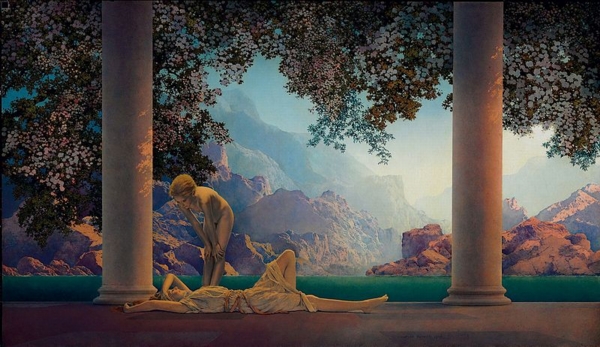
(above: Maxfield Parrish, Daybreak, c. 1922, oil on board, 26? x 45 inches, Christie's. Public domain, via Wikimedia Commons*)
Another of Parrish's major works, The Dream Garden (1914-1915), demonstrates the monumental scale his popular art could achieve. This was a massive mural commissioned for the lobby of the Curtis Publishing Building in Philadelphia, executed not in paint, but in glass mosaic. It was the only collaboration between Parrish and the great glass master Louis Comfort Tiffany. Composed of over one hundred thousand individual pieces of iridescent "favrile" glass, the work translates Parrish's painterly vision of an idyllic landscape into a shimmering, permanent architectural installation. The project was a landmark of American public art, but it also highlighted the tensions between fine art and decorative craft. Parrish himself was famously dissatisfied with the final result, feeling that the 260 colors available in glass could not capture the subtle gradations of his painting. Together, the art of Saint-Gaudens and Parrish reveals the dual nature of the American Renaissance as it played out in Cornish: a simultaneous drive to create a grand, historical narrative for the nation's public spaces and to beautify the private, domestic sphere through accessible, mass-produced imagery.
The Monadnock Mystique: The Dublin Colony and the Transcendental Spirit
While the Cornish Colony was building an American Arcadia on the banks of the Connecticut River, a different kind of artistic community was forming in the shadow of Mount Monadnock. The Dublin Colony was smaller, quieter, and more philosophical than its bustling counterpart to the northwest. Its members were drawn not by a desire for a lively social scene, but by the solitary, spiritual presence of the mountain itself, a landmark that had inspired New England Transcendentalists like Ralph Waldo Emerson and Henry David Thoreau a generation earlier. The central artistic figure of this introspective circle was the painter Abbott Handerson Thayer, a man whose life and art were profoundly shaped by the landscape he called home.
Thayer was born in Boston in 1849 but spent much of his childhood in rural New Hampshire, near Keene, at the foot of Monadnock, where he developed a passionate, lifelong love of nature and birds. After studying in Paris and establishing a successful career as a portrait painter in New York, a series of personal tragedies, culminating in the death of his first wife from tuberculosis in 1891, drove him from the city. He sought refuge in the wilderness of the Monadnock region, eventually settling permanently in Dublin in 1901. Thayer's life was marked by a profound eccentricity and a lifelong struggle with what would now be diagnosed as bipolar disorder, a condition he called "the Abbott pendulum". For him, nature, and Monadnock in particular, was not just a subject for art but a source of spiritual solace and psychological stability. He saw the mountain as a "natural cloister," a "sacred totem," and his art became a vehicle for expressing the Emersonian belief that the divine permeates the natural world.
Thayer's work represents a significant pivot in New Hampshire art, turning the landscape from an external subject to be depicted into an internal, psychological space. His most famous paintings are not landscapes in the traditional sense, but idealized portraits of women and children, often depicted as angels. A pivotal work, Angel, painted in 1887, is both a tender portrait of his eleven-year-old daughter, Mary, and a universal allegory of innocence and spirituality. The importance of this painting lies in its fusion of the deeply personal with the transcendent. Thayer explained that he added wings to his figures not for any specific religious narrative, but to "symbolize an exalted atmosphere" and to elevate his subjects "above the realm of genre painting". The painting's ethereal quality, achieved through his unorthodox technique of manipulating the paint with his fingers, scrapers, and even brooms, reflects his obsessive quest to capture not a mere physical likeness, but what he called "highest human soul beauty".

(above: Abbott Handerson Thayer, Angel, 1887, oil on canvas, 36.2 x 28.1 inches, Smithsonian American Art Museum. Public domain, via Wikimedia Commons*
Another major work, A Virgin (1892-93), expands this vision. The painting depicts his three children -- Mary in the center, flanked by her younger siblings Gerald and Gladys -- striding forward with resolute purpose against an expansive, cloud-filled sky. The work is a powerful embodiment of the American Renaissance ideal, consciously linking his contemporary American children to the legacy of classical antiquity; the pose of his daughter Mary directly recalls the famous Hellenistic sculpture, the Winged Victory of Samothrace Painted in the years following his wife's death, the work conveys an overwhelming sense of strength, nobility, and resilience in the face of loss. It showcases his mature style, with its ambiguous space and varied, energetic paint application, which prioritizes emotional and spiritual gravitas over polished, realistic detail.For Thayer, the landscape of Monadnock was a therapeutic and spiritual resource, and his paintings became the externalizations of his intense internal search for purity, stability, and transcendence.
A Lasting Legacy on the American Scene
The history of representational art in New Hampshire before 1945 is a rich and layered story of evolution. It begins with the discovery of a raw, sublime wilderness by artists of the Hudson River School, whose dramatic canvases introduced the nation to the formidable beauty of the White Mountains. This initial exploration gave rise to the White Mountain School, a commercially successful and prolific movement led by Benjamin Champney, which defined the region's cultural identity for generations and inextricably linked the worlds of art and tourism.
As the Gilded Age dawned, this model evolved into the more sophisticated and intentional art colonies. In the Connecticut River Valley, the Cornish Colony, under the leadership of the great sculptor Augustus Saint-Gaudens, became a national center for the American Renaissance, a place where monumental public art and wildly popular illustration flourished side-by-side, reflecting the era's dual ambitions to build a grand civic culture and to beautify the domestic sphere. In the shadow of Mount Monadnock, the quieter Dublin Colony offered a more introspective retreat, where an artist like Abbott Handerson Thayer could turn inward, using the landscape as a canvas for his personal search for spiritual truth and psychological solace.
The state nurtured artists who became towering figures on the national stage, from regional champions like Champney to artists of international stature like Saint-Gaudens, Thayer, and the immensely popular Maxfield Parrish. The legacy of these creative communities culminated in the founding of the MacDowell Colony, which transformed the very idea of an art colony into the modern, institutionalized artist residency-a philanthropic model designed to foster innovation that would be replicated across the country, supporting generations of America's most important artists, writers, and composers.
Ultimately, New Hampshire's most profound contribution to American art history is not a single, monolithic style, but its role as a crucial incubator for different, evolving models of what it meant to be an American artist. It provided the physical and imaginative space for creative individuals to work through the nation's changing relationship with nature, culture, and commerce. From market-savvy landscapists and Beaux-Arts masters to tormented idealists and commercial visionaries, the Granite State was the canvas on which they painted their diverse and enduring visions of America.
We added images and links to other materials
to this Gemini article to make it more interesting and educational
for your benefit. Although Gemini is rapidly improving its accuracy,
the article may have inaccurate information. It's safest to consider
it a base for further inquiry.
Our prompt to Gemini 2.5 Pro:
 Return to New Hampshire Art History
Return to AI Curiosities
*Tag for expired US copyright of object image:

Links to sources of information outside of our web site are provided only as referrals for your further consideration. Please use due diligence in judging the quality of information contained in these and all other web sites. Information from linked sources may be inaccurate or out of date. TFAO neither recommends or endorses these referenced organizations. Although TFAO includes links to other web sites, it takes no responsibility for the content or information contained on those other sites, nor exerts any editorial or other control over them. For more information on evaluating web pages see TFAO's General Resources section in Online Resources for Collectors and Students of Art History.
Copyright 2025 Traditional Fine Arts Organization, Inc. an Arizona nonprofit corporation. All rights reserved.
