
AI Curiosities
Circles of Light: The Parasol, Japonisme, and the California Impressionists
By Gemini 2.5 Pro - August 2025
Introduction: California Sun and the Paper Parasol
Picture a sun-drenched canvas from the early 20th century. The setting is quintessentially Californian: a golden hillside overlooking the Pacific, or perhaps a lush garden in Pasadena, bursting with poppies and eucalyptus. At the center of this scene stands a woman, her white dress a brilliant canvas for the dappled light filtering through the trees. Her face, turned slightly away, is softly illuminated by the colored glow of a parasol held aloft. This image -- the elegant woman of leisure shielded by her sunshade -- is an archetype of California Impressionism, a recurring motif that seems to capture the very essence of the time and place.

(above: Jean Mannheim (1863-1945), Sunny Portrait, before 1945, tuttartpitturasculturapoesiamusica.com. Public domain, via Wikimedia Commons*)
But why was this particular scene so compelling to the painters who flocked to the Golden State? The answer, it turns out, is far more complex than a simple chronicle of fashion or a practical need for shade. The parasol, in the hands of the California Impressionists, becomes a nexus point, a vibrant circle where the state's unique environmental conditions, the social aspirations of a burgeoning society, and a profound artistic dialogue with Japan converge. It is a compositional tool for mastering light, a cultural symbol of a new, leisurely way of life, and a quiet homage to an aesthetic revolution that arrived from across the Pacific. To understand the parasol in these paintings is to unravel the very story of California Impressionism itself -- a story of light, leisure, and a transformative encounter with the art of the East.
A New Eden: Painting California's Radiant Light
The Lure of the Golden State
At the turn of the 20th century, California was more than a geographic location; it was a potent idea. Decades after the Gold Rush had radically transformed its destiny, the state was still being mythologized as a "land of boundless resources and unlimited opportunities" and a "new Eden of perpetual sunshine". It was an "outpost on the Pacific," half a continent removed from the established cultural centers of the East Coast, promising a fresh start and a life lived in harmony with nature. This powerful narrative drew a wave of artists from across the United States and Europe. Painters like William Wendt, Guy Rose, and Franz Bischoff, most of whom were not native to the state, arrived between 1900 and the early 1920s, bringing with them formal artistic training and a shared desire to capture the unique character of this promised land.
These artists were not merely passive observers of the landscape; they were active participants in the construction of the "California Dream." The Impressionist style, with its focus on idyllic, sun-drenched scenes rendered in brilliant color, provided the perfect visual language to articulate and amplify the myth of California as a gentle, therapeutic paradise. Their canvases became powerful cultural documents, shaping the state's identity as a sun-blessed haven, an image that would soon be broadcast to the world by the nascent film industry in Hollywood.
The Religion of Light
The defining characteristic of the movement that these artists forged, known interchangeably as California Impressionism or the California Plein-Air School, was a profound obsession with capturing the state's extraordinary light. Their work was fundamentally "concerned with light and color," specifically the "abundant California light" that seemed to saturate every landscape. Artists were deeply inspired by the "clarity and force of the distinctive light of Southern California," a quality that set the region apart from the hazy, atmospheric conditions of the East Coast or Europe. This focus transcended mere technical interest. For many of these painters, the act of capturing light was a quasi-spiritual pursuit. The American landscape was seen as a "fountainhead" of national identity and spirit, a place where "God and Nature" were perceived as one. In California, this belief found its ultimate expression in the brilliant, life-giving sun. Light was the "creative instrument," and to paint it was to engage with a divine energy. This spiritual reverence for nature elevated their artistic practice into a deeply felt mission: to translate the sublime experience of California's landscape onto canvas.
The Plein Air Imperative
To achieve this goal, artists embraced the practice of painting outdoors, or en plein air. This method, inherited directly from their French Impressionist predecessors, was essential for capturing the fleeting, momentary effects of natural light and atmosphere. California's year-round mild climate was perfectly suited to this approach, allowing painters to work directly from nature throughout the seasons.
To facilitate this immersive practice, vibrant art colonies sprang up in areas of remarkable natural beauty, most notably in the coastal communities of Laguna Beach and Carmel-by-the-Sea, where artists could live, work, and exhibit together. Their easels dotted the hillsides and shorelines, as they worked quickly to capture the "temporal fragment" of a sunlit moment before the light shifted and the scene transformed.
The Fashionable Sphere: Symbolism of the Parasol in an Age of Leisure
An Accessory of Status and Femininity
In the sun-drenched world the California Impressionists sought to portray, the parasol was a ubiquitous and deeply symbolic object. Its most basic function was, of course, practical. In an era when a fair, untanned complexion was a primary signifier of high social status -- a clear marker of a life of leisure, removed from the necessity of outdoor labor -- the parasol was an essential tool for protecting the skin. However, its significance extended far beyond utility. Historically, the parasol had been an emblem of royalty and divinity, a symbol of "dignity and holiness" reserved for the privileged few. By the late 19th and early 20th centuries, it had evolved into an indispensable fashion accessory for the modern, well-to-do woman. It was considered so integral to the female silhouette that, as one period observer noted, a woman's profile was "more complete when she carried a parasol".
The number, color, and quality of a woman's parasols served as a direct reflection of her wealth and social standing. While less affluent women might own a single black or white parasol for formal occasions, the wives and daughters of the wealthy possessed a "veritable rainbow of flamboyant colors," with different designs for specific events, such as a stroll in the park or a ride in a carriage.
The Impressionist's Prop
This rich cultural symbolism made the parasol an ideal motif for Impressionist painters, both in Europe and America. Artists like Claude Monet, in his iconic Woman with a Parasol (1875), and Pierre-Auguste Renoir established a powerful artistic precedent, using the parasol to frame their depictions of modern, middle-class life and leisure. American painters such as John Singer Sargent followed suit, incorporating the motif into their own explorations of light and society. For the California painters, who were deeply engaged in a dialogue with their European counterparts, the woman with a parasol was a ready-made subject, rich with established artistic and social meaning. Yet, for artists so singularly focused on the challenge of painting light, the parasol offered something more. It was not merely a passive prop but an active compositional tool -- a portable device for manipulating light and color within the landscape.
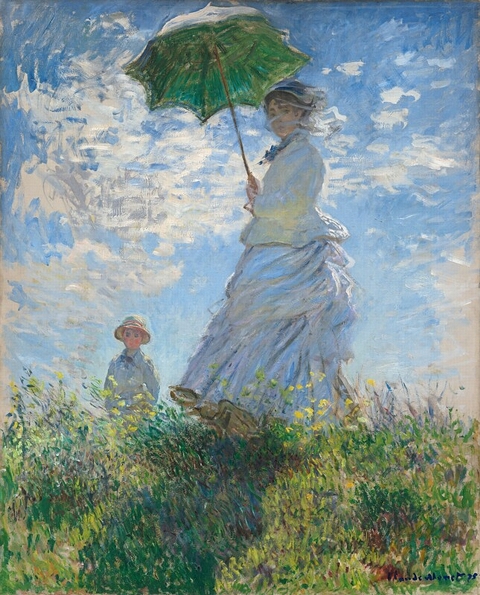
above: Claude Monet, Woman with a Parasol - Madame Monet and Her Son, 1875, oil on canvas, 39 3/8 x 31 7/8 inches. National Gallery of Art, Washington DC, Collection of Mr. and Mrs. Paul Mellon, 1983.1.29)
The very nature of a parasol is to interact with the sun. It creates a distinct circle of cool, deep shadow, providing a dramatic contrast to the brilliant, warm sunlight that surrounds it. This juxtaposition allowed painters to explore the scientific color theories of chemists like Eugène Chevreul, whose principles of simultaneous contrast were central to the Impressionist technique of placing complementary colors side-by-side to heighten their intensity. Furthermore, the fabric of the parasol acted as a delicate filter, casting a soft, colored, diffused light onto the subject's face and dress. This created an opportunity to paint complex and subtle color harmonies -- the cool lavender of a shadow on a white dress, the warm pink glow reflected on a cheek. -- turning the human figure into a canvas for the intricate play of light and color. Its strong geometric shape -- a perfect circle or semi-circle -- also served as a powerful design element, capable of framing the figure, anchoring the composition, and creating a focal point that draws the viewer's eye into the scene. For the California Impressionists, the parasol was a perfect instrument for their artistic investigations.
A Wave from the East: The Transformative Influence of Japonisme
While the California Impressionists were inheriting the subject of the woman with a parasol from their Western predecessors, the way they often chose to paint her -- and the world around her -- was profoundly shaped by an artistic revolution that originated in the East. In 1853 and 1854, Commodore Matthew Perry's naval expedition effectively forced Japan to end centuries of self-imposed isolation and open its ports to international trade. This historic event unleashed a flood of Japanese art, fashion, and decorative objects into Europe and America, igniting a widespread cultural fascination known as Japonisme.
The Revelation of Ukiyo-e
At the heart of this phenomenon were Japanese woodblock prints known as ukiyo-e. Translating to "pictures of the floating world," these were inexpensive, mass-produced images that celebrated the ephemeral pleasures of urban life in Edo-period Japan (1615-1868). They depicted the world of leisure and entertainment: glamorous courtesans, famous kabuki actors, serene landscapes, and intimate domestic scenes. For Western artists, encountering these prints was a revelation. They presented a visual language that was radically different from the conventions of European academic art, which, since the Renaissance, had been preoccupied with creating a convincing illusion of three-dimensional space. Ukiyo-e artists, by contrast, embraced the two-dimensional surface, employing flattened perspectives, asymmetrical compositions, dramatic cropping of figures at the edge of the frame, strong diagonal lines, and bold, flat areas of unmodulated color.
The Impressionist Embrace
This new aesthetic arrived at the perfect moment for the Impressionists in Paris, who were themselves seeking to break free from the rigid doctrines of the academy. Artists like Edgar Degas, Mary Cassatt, and Claude Monet became avid collectors of ukiyo-e prints, drawing profound inspiration from their innovative compositions and decorative beauty. As the painter Camille Pissarro wrote after seeing an exhibition of ukiyo-e in 1893, "These Japanese artists confirm my belief in our vision". The influence was direct and transformative. Monet's famous water garden at Giverny, with its iconic Japanese-style footbridge, was inspired by motifs he saw in prints by artists like Hokusai and Hiroshige. Mary Cassatt, after her visit to the 1890 ukiyo-e exhibition, produced a series of ten color etchings that directly employed Japanese principles of flattened space, simplified figures, and decorative patterns.
For these artists, Japonisme was not merely a source of exotic subject matter or a passing stylistic trend. It was a conceptual breakthrough. The sophisticated, fully-realized aesthetic of ukiyo-e provided a powerful precedent that validated their own revolutionary impulses. It gave them, in essence, the "permission" to abandon the strictures of Western illusionism and pursue a more modern art based on subjective vision, decorative harmony, and the expressive power of line and color.
The California Connection: Synthesizing Light and Line
The aesthetic principles of Japonisme, having transformed art in Paris, traveled with the painters who made their way to California. On the sunlit coast of the Pacific, these imported ideas found fertile new ground, merging with the unique light and landscape to create a distinct regional style. The woman with a parasol became a central figure in this synthesis, a motif where the influences of Giverny and Edo converged.
Case Study: Guy Rose's The Green Parasol
No artist better embodies this connection than Guy Rose. A native of San Gabriel, Rose was one of the few leading California Impressionists actually born in the state. He trained in Paris and, crucially, spent more than a decade living and painting in Giverny, where he became one of the few American artists of his generation to befriend Claude Monet. When Rose returned to California in 1914, he brought with him a direct and intimate understanding of French Impressionism at its source. His painting, The Green Parasol (c. 1909-1911), is a masterclass in this cultural and artistic fusion. Described as "perhaps the archetypal Giverny figure picture," it depicts a woman seated by the water, her form a study in the effects of dappled sunlight.
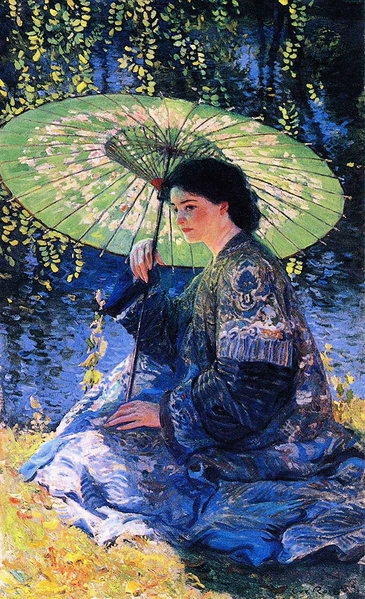
(above: Guy Rose, The Green Parasol, 1911, oil on canvas, 31 x 19 inches. Public domain, via Wikimedia Commons*)
Significantly, she wears a "favored patterned kimono and holds a decorative parasol, both reflections of the contemporary preference for Japanese motifs". Here, the link to Japonisme is made explicit. Rose combines the quintessential Impressionist subject -- a woman outdoors, a study in light -- with two overt symbols of the Japanese aesthetic. The parasol is not just a Western fashion accessory; it is presented as part of a complete aesthetic package that directly acknowledges the influence of Japanese art and design. The painting thus becomes a visual manifesto, a deliberate synthesis of the light of Giverny and the decorative principles of Edo.
The "Dow Pipeline": Systematizing Japanese Aesthetics for American Artists
While many artists absorbed the influence of Japonisme through exhibitions and personal collections, its principles were also disseminated through a more structured, pedagogical channel. The pivotal figure in this process was the American artist and educator Arthur Wesley Dow. In the 1890s, after a transformative encounter with the woodblock prints of Hokusai at the Boston Public Library, Dow rejected the traditional European method of teaching art through imitation. He developed a revolutionary new curriculum based on the fundamental principles of Japanese design: the harmonious arrangement of line, color, and Notan -- the Japanese concept of massing light and dark values for compositional balance.
Dow's landmark 1899 textbook, Composition, codified these ideas and became a standard text in schools across the country for decades. Through his influential teaching positions at institutions like the Pratt Institute and Columbia University, Dow's Japanese-derived methods shaped a generation of American artists and educators. This created a direct pipeline through which the core tenets of Japanese aesthetics were systemically injected into American art education. This pipeline extended directly to the heart of the California Impressionist movement.
Anna Althea Hills, a leading painter in the Laguna Beach art colony and a driving force behind the founding of the Laguna Art Museum, studied directly with Arthur Wesley Dow. This connection demonstrates that the Japanese influence in California was not always a matter of indirect inspiration or stylistic borrowing. In some cases, it was the result of formal training in an educational system explicitly built upon the foundations of Japanese art theory.
The Decorative Impulse: California's "Floating World"
The influence of Japanese design principles is evident in the work of numerous California painters. Donna Schuster, who studied with the great American Impressionist William Merritt Chase, created a series of paintings of water lilies clearly inspired by Monet. Yet, critics have noted that her works often achieve a "more decorative, flattened, two-dimensional effect, reminiscent of Far Eastern prints".
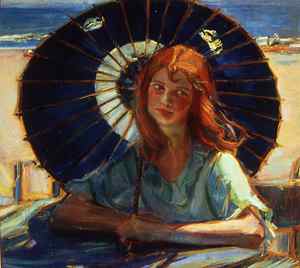
(above: Donna Schuster, (1883-1953), On the Beach, c. 1917, oil on canvas, 29 1/8 x 29 1/4 inches. UC Irvine Jack and Shanaz Langson Institute and Museum of California Art. Gift of The Irvine Museum. Image from TFAO article: A Woman's Touch: Selected Women Artists in California.)
This decorative impulse, this emphasis on pattern and flat planes of color over illusionistic depth, is a direct legacy of Japonisme. There is also a fascinating thematic parallel. The term ukiyo-e celebrated the "floating world" of fleeting pleasures in urban Japan. In their own way, the California Impressionists were documenting a new "floating world" -- the idyllic, sun-drenched, leisurely lifestyle of the California "Eden". The elegant woman with her parasol, captured in a moment of quiet repose in a garden or by the sea, becomes the central figure in this new, Californian floating world.
By employing the flattened, patterned, and compositionally bold aesthetics learned from ukiyo-e, artists were able to map the visual language of one idealized world of leisure onto another.
Conclusion: More Than Just Shade
The parasol that appears so frequently in the sunlit canvases of California Impressionism is far more than a charming period accessory. It is a complex and multifaceted object, a focal point where the major forces that shaped this unique regional art movement converge. It is, first and foremost, a masterful compositional device. For painters obsessed with capturing the brilliant, ever-changing light of the Golden State, the parasol was an indispensable tool. It allowed them to stage and study the complex interplay of direct sunlight, cool shadow, and colored, reflected light, turning the human figure into a landscape of optical effects. Second, it is a potent social signifier. The parasol is a cultural shorthand for the leisurely, civilized, and prosperous lifestyle that defined the "California Dream."
Its presence instantly tells a story of class, modern femininity, and a life lived in harmony with the state's benevolent climate, reinforcing the myth of California as a new American Eden. Finally, and most profoundly, it is a sophisticated aesthetic homage. Its inclusion, often alongside other Japanese-inspired motifs like kimonos and decorative patterns, is a direct acknowledgment of the artistic principles of Japonisme. It signals an allegiance to a modern, decorative vision of art, one liberated from the constraints of academic tradition by the revolutionary example of the Japanese ukiyo-e print. Thus, these seemingly simple paintings of women in sunlit gardens are, in fact, rich cultural documents. They capture a unique moment in history when the brilliant light of a "New Eden" on the Pacific coast was filtered through an artistic lens crafted half a world away in Japan. In the simple, elegant circle of a parasol, we find a complex and global story of artistic exchange, cultural aspiration, and creative innovation.
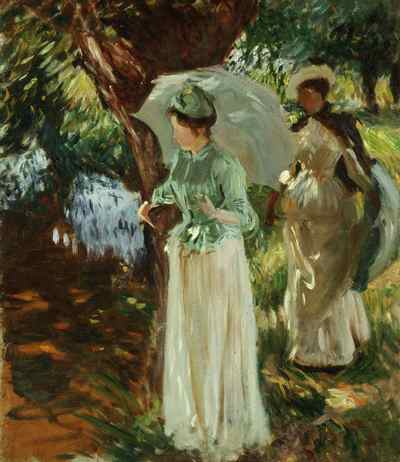
(above: John Singer Sargent, 1856-1925, Two Girls with Parasols at Fladbury, c. 1889, oil on canvas - from Light Motifs: American Impressionist Paintings from The Metropolitan Museum of Art (7/28/05)
 Go to more parasol images
Please don't rely on this AI-generated text for accuracy. It has been edited, yet may have inaccurate information. A table is deleted becuase of formatting incompatibility. Consider it a base for further inquiry. Links are ours. Nonessential parts of the report were deleted.
 return to AI Curiosities
*Tag for expired US copyright of object image:

TFAO Museum of American Art is proudly sponsored by Traditional Fine Arts Organization, Inc., an Arizona nonprofit corporation. All rights reserved. © 2024
Links to sources of information outside of this website are provided only as referrals for your further consideration. Please use due diligence in judging the quality of information contained in these and all other web sites. Information from linked sources may be inaccurate or out of date. TFAO neither recommends or endorses these referenced organizations. Although TFAO includes links to other web sites, it takes no responsibility for the content or information contained on those other sites, nor exerts any editorial or other control over them. For more information on evaluating web pages see TFAO's General Resources section in Online Resources for Collectors and Students of Art History.