
Arizona Oil Painting and Sculpture: 1900-1930
by Gemini AI
May. 2025
A Frontier Transformed
The period from 1900 to 1930 marks a pivotal period in Arizona's history, witnessing its dramatic transformation from a rugged U.S. Territory to the 48th state in 1912. Mining, cattle ranching, and agriculture boomed, attracting diverse settlers, including European immigrants, African Americans, and Chinese laborers, alongside existing Hispanic and Native American communities.
Amidst this dynamic and often challenging environment, art continued to serve as a profound expression of identity, faith, and the human spirit. While the traditional devotional art forms persisted, a new wave of American artists arrived, drawn by the allure of the "last frontier." Their oil paintings and sculptures, whether realistic or idealized, sought to capture the majestic beauty of the Southwestern landscape, document the lives of its diverse inhabitants, and convey a sense of positive virtues and spiritual upliftment in a rapidly changing world. Art became a visual chronicle of Arizona's journey, reflecting both the rugged realities of frontier life and the enduring aspirations for progress and cultural understanding.
The Shifting Artistic Landscape
The American West became a captivating subject for artists from across the nation. Drawn by the vast, dramatic landscapes, the unique quality of Southwestern light, and the perceived romance of frontier life, these artists, many from Eastern cities, flocked to the region. Their work, predominantly oil paintings, aimed to document and interpret the West for a national audience, often blending meticulous realism with a sense of romantic idealism. They captured expansive skies, mesas, and canyons, distilling their "radiant beauty, intense color, and majestic grandeur" onto canvas.
This period also saw the emergence of artists who specifically focused on Arizona's unique cultural history and landscapes. After statehood in 1912, there was a conscious effort to define and celebrate Arizona's distinct identity through art, depicting its "people and landscapes" and industries. Artists explored themes ranging from Native American culture and early Spanish colonization to the Grand Canyon, mining, and the "five Cs" (copper, cattle, citrus, climate, and cotton) that shaped the state's economy. This art not only preserved historical moments but also fostered a sense of shared heritage and pride, emphasizing the resilience and spirit of the communities that built the new state.
Key Artists and Their Creative Inspirations
The artists of this era, whether documenting the vanishing frontier or celebrating the emerging state, shared a common thread: a deep engagement with the American West and a desire to convey its essence through their chosen mediums.

(above: Frederic Remington (American, 1861-1909). The Broncho Buster, 1895, revised 1909, cast by November 1910. Bronze, 32 1/4 x 27 1/4 x 15 inches. The Metropolitan Museum of Art, New York, Bequest of Jacob Ruppert, 1939 (39.65.45). Public domain, via Wikimedia Commons*)
Paintings by Frederic Remington

(above: Thomas Moran, Grand Canyon with Rainbow. 1912. Oil on canvas. de Young Art Museum. Gift of Mr. and Mrs. Robert F. Gill through the Patrons of Art and Music. 1981.89. License: Scuttlebutte, CC BY-SA 4.0 Scuttlebutte, CC BY-SA 4.0. via Wikimedia Commons**)
More paintings by Thomas Moran
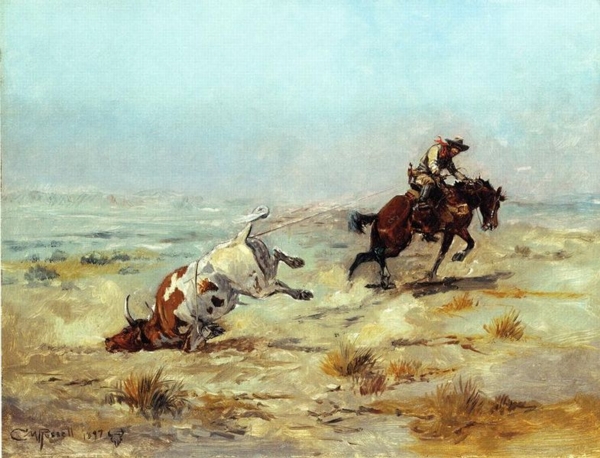
(above: C.M. Russell, Lassoing A Steer, 1897, oil on board 18.5 x 24.5 inches, Private collection. Public domain, via Wikimedia Commons*)
More paintings and Sculpture by C. M Russell

(above: Maynard Dixon, Home of the Desert Rat, c. 1944-1945, oil on canvas, Phoenix Art Museum. Public domain, via Wikimedia Commons*)
More paintings by Maynard Dixon

(above: Gutzon Borglum and Lincoln Borglum, Mount Rushmore National Memorial, 1927 to 1941. Photo courtesy of National Park Service Image Gallery)
Art as a Mirror of Virtue and Resilience
Throughout this transformative period, art in Arizona served as a powerful reflection of the state's evolving identity and the enduring human spirit. The shift from a predominantly devotional art form to a broader spectrum of Western and regional art mirrored the societal changes, yet the underlying emphasis on beauty, positive virtues, and spiritual upliftment remained constant.
Artists like Remington and Russell, through their depictions of cowboys and soldiers, celebrated virtues of courage, self-reliance, and perseverance that were central to the frontier myth. Moran and Dixon, in their majestic landscapes, conveyed the awe-inspiring beauty of the natural world, fostering a sense of wonder and connection to the land that could uplift spirits amidst hardship. Mary-Russell Ferrell Colton, through her art and advocacy, actively worked to preserve and promote the cultural heritage of Arizona's Native peoples, recognizing art's essential role in human well-being and community identity.
This era's art was not merely decorative; it was a vital cultural force. It helped communities navigate rapid change, provided solace and inspiration, and visually reinforced shared values. The blending of artistic traditions and the focus on Arizona's unique landscapes and peoples created a distinct artistic legacy that continues to tell the story of a frontier transformed into a vibrant state, a testament to the enduring power of art to reflect and shape human experience.
A Legacy Forged in Transition
From 1900 to 1930 was a period of profound artistic evolution in Arizona. As the territory embraced statehood and modernization, oil painting and sculpture moved beyond their earlier devotional focus to encompass the vastness of the American West and the unique character of Arizona itself.
The works of artists like Frederic Remington, Thomas Moran, Charles M. Russell, Maynard Dixon, and Mary-Russell Ferrell Colton collectively captured the essence of this dynamic era. Through their diverse styles and subjects, they emphasized beauty, positive virtues, and the uplifting of spirits, whether by romanticizing the vanishing frontier, celebrating the grandeur of the landscape, or portraying the dignity of its diverse inhabitants. This period laid the groundwork for a rich and multifaceted artistic heritage in Arizona, demonstrating how art adapted to, documented, and ultimately helped define a rapidly changing region, leaving a lasting legacy of visual storytelling and cultural pride.
Please don't rely on this AI-generated
text for accuracy. It has been lightly edited, yet may be laden with inaccurate
information. Consider it a base for further inquiry.
 Return to Arizona Art History
Return to Topics in American Representational Art
*Tag for expired US copyright of object image:

TFAO Museum of American Art is proudly sponsored by Traditional Fine Arts Organization, Inc., an Arizona nonprofit corporation. All rights reserved. © 2024
Links to sources of information outside of this website are provided only as referrals for your further consideration. Please use due diligence in judging the quality of information contained in these and all other web sites. Information from linked sources may be inaccurate or out of date. TFAO neither recommends or endorses these referenced organizations. Although TFAO includes links to other web sites, it takes no responsibility for the content or information contained on those other sites, nor exerts any editorial or other control over them. For more information on evaluating web pages see TFAO's General Resources section in Online Resources for Collectors and Students of Art History.
 Search Resource Library
Copyright 2025 Traditional Fine Arts Organization, Inc., an Arizona nonprofit corporation. All rights reserved.