
AI Curiosities
Florida Art History, 1885-1945:
A Narrative of Beauty and Upliftment, by Gemini 2.5, 2025
The period from 1885 to 1945 marked a profound transformation for Florida, evolving from a largely undeveloped frontier into a burgeoning destination. This era of rapid growth, economic shifts, and global conflicts profoundly shaped the state's artistic landscape. Within this dynamic backdrop, oil painting and sculpture in Florida consistently gravitated towards themes of beauty, positive virtues, and the uplifting of spirits. Artists, whether through realism or idealism, sought to capture the state's natural grandeur, the human spirit, and the promise of a new frontier.
The state's emergence was significantly propelled by the vision of industrialists like Henry Flagler, whose Florida East Coast Railway, initiated in 1885, linked the state's east coast and facilitated the development of grand hotels such as the Hotel Ponce de Leon in St. Augustine. Florida quickly became a magnet for tourists, from the affluent "robber barons" to the more modest "tin can tourists," drawn by its warm climate and pristine beaches. Aggressive marketing campaigns and celebrity endorsements further fueled this influx, particularly during the 1920s land boom, leading to rapid population growth and the development of new communities like Coral Gables.
The extensive railroad and hotel infrastructure developed by Flagler directly enabled the explosion of tourism in Florida. This influx of visitors, particularly wealthy northerners, created a new market for art that celebrated Florida's unique environment. Art became not just a decorative element for the newly built luxury hotels but also a form of advertising, showcasing the state's "natural splendor" and "bucolic" allure. This top-down patronage from developers and wealthy tourists naturally encouraged artists to focus on themes of beauty, positive virtues, and scenes that would uplift spirits.
Descriptions of Florida as a "largely uninhabited frontier" with "warm subtropical areas, sea breezes, and vast wilderness teeming with exotic wildlife" highlight its unique appeal. The allure of escaping the "dirty, overcrowded city" positioned Florida as an idyllic subject for artists seeking to capture natural beauty and serenity. This inherent appeal of the landscape itself served as a profound and consistent source of inspiration for artists, directly contributing to the uplifting and beautiful art produced.
Early Brushstrokes: Gilded Age and Natural Splendor (1885-1910s)
Henry Flagler's vision for Florida extended beyond infrastructure and tourism; it inadvertently fostered early artistic communities. His grand Hotel Ponce de Leon, opened in St. Augustine in 1888, was not merely a luxury resort but also a canvas for significant artistic commissions, featuring murals by artists such as George Willoughby Maynard and Virgilio Tojetti. Flagler's personal interest in art also played a direct role in attracting talent. Notably, he took an interest in the work of Martin Johnson Heade, inviting him to St. Augustine in 1883, where Heade became a pivotal figure in a nascent artist colony. This direct patronage and the establishment of luxurious resorts created a demand for art that reflected and promoted the idealized image of Florida as a beautiful, serene destination.

(above: Martin Johnson Heade, Roses, 1876, oil on board, 15 1/4 x 12 3/4 inches, Christie's. Public domain, via Wikimedia Commons*)
The repeated presence of artists forming "colonies" in Florida, starting with Heade in St. Augustine and later exemplified by George Inness Jr.'s "Inness Manor" in Tarpon Springs, reveals a significant trend. In a developing state with limited formal art institutions, these artist communities served as crucial hubs. They provided a supportive environment for creative exchange, attracted other artists, and likely facilitated patronage, thereby accelerating the growth and visibility of Florida's art scene during this formative period. This communal aspect would have fostered a shared vision of Florida's beauty and potential, contributing to the positive themes in the art.

(above: George Inness, Near the Village, October, c. 1892, oil on canvas, 45 x 30 inches, Cincinnati Art Museum. Public Domain, via Wikimedia Commons*)
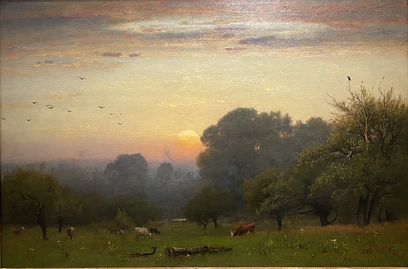
(above: George Inness, Morning, c, 1878, oil on canvas mounted on cardboard, 76.2 x 114.3 cm, Museo Nacional Thyssen-Bornemisza, Madrid, Inv. no. 600 (1983.4. Photo 2024 by John Hazeltine)
Artist Spotlight: Martin Johnson Heade (1819-1904) A prominent figure in late 19th-century American art, Martin Johnson Heade was born in Lumberville, Pennsylvania, and received his early training from folk artist Edward Hicks.After extensive travels in Europe and working as an itinerant portrait painter, he developed a profound interest in landscape art, associating with the Hudson River School. In 1883, at the age of 64, Heade settled in St. Augustine, Florida, where he spent the last 21 years of his life, creating some of his most important works. His work, though not widely recognized during his lifetime, was rediscovered in the 1940s, cementing his significance in American art.
Heade's Florida period was marked by luminous scenes that captured the "beauty and serenity of the area's subtropical marshland" and "brilliant floral paintings of coastal environs, flowers and wildlife". He found particular inspiration in indigenous flowers like magnolias and Cherokee roses, often depicting them as exquisite still lifes. His marsh paintings, characterized by their "ethereal light" and "strong horizontal format," conveyed a sense of "timeless solitude and awe-inspiring quality of the natural world," reflecting a "metaphysical through sublime nature".
These works, especially River at Twilight (c. 1880-85), illustrate a profound tranquility and a "new mood" of peace that Heade found in Florida. Heade was also an early advocate for the preservation of Florida's natural resources, a virtue reflected in his artistic celebration of its unspoiled beauty. Heade's early association with the Hudson River School suggests a background in the grand, dramatic landscapes characteristic of American Romanticism. However, his move to Florida and his focus on "serenity" and the "quiet, contemplative quality of marshlands" indicates a shift. While still imbued with a sense of the sublime, his Florida works embraced a more intimate and detailed realism, capturing the unique, delicate beauty of the state's specific environment rather than just its dramatic vistas. This evolution reflects a growing artistic maturity and a deeper engagement with the particularities of the Florida landscape, allowing for a more nuanced portrayal of beauty and peace.
The Roaring Twenties: Boom, Bust, and Artistic Flourishing (1920s)
The 1920s brought an unprecedented "massive land boom" to Florida, fueled by post-WWI prosperity, improved transportation, and aggressive marketing. This era saw rapid population growth and urban development, with new planned communities like Coral Gables and Boca Raton emerging, designed for "luxurious living". This period of affluence created a demand for art that reflected optimism and aspiration. However, the boom was followed by a devastating bust, exacerbated by natural disasters like the Great Miami Hurricane of 1926. This downturn had "lasting consequences," leading to economic diversification and a shift in cultural priorities. The architectural heritage, particularly Art Deco and Mediterranean Revival styles, from this boom era continues to define Florida's unique cultural identity.
The economic boom of the 1920s fostered an environment where art could celebrate "luxurious living" and the aspirational vision of Florida. This encouraged themes of beauty, leisure, and idealized landscapes. However, the abrupt and severe bust, followed by the Great Depression, necessitated a shift in artistic focus. Artists then turned to themes of resilience, community, and the struggles of everyday people, often through government-sponsored programs. This dual experience likely led to a blend of enduring idealism, reflecting hope for recovery and a better future, and a more grounded realism, depicting lived experiences, setting the stage for the public art of the following decade.
Artist Spotlight: George Inness Jr. (1853-1926) The son of the celebrated 19th-century American painter George Inness, George Inness Jr. was born in Paris and received a comprehensive art education, influenced by the Barbizon School. In 1902, he established a winter residence in Tarpon Springs, Florida, which evolved into "Inness Manor," an important artist colony that hosted notable artists like Winfield Scott Clime and Charles Curran. He passed away in 1926, just as the Florida land boom was collapsing. Inness Jr. is renowned for his "spiritual landscapes of soft-edged, mid-range tonality," which set his work apart from his father's darker atmospheric pieces. His art was deeply influenced by Emanuel Swedenborg's theology, believing that "everything in nature had a correspondence relationship with something spiritual". He sought to reveal the "reality of the unseen" and connect the "visible upon the invisible," conveying a "deep reverence for the mysticism contained within one's simple natural surroundings". In Tarpon Springs, he created an "eleven-painting suite of landscape and mystical works" (1918-1926) for the Unitarian Universalist Church, which includes profoundly uplifting pieces like The Lord is in His Holy Temple (1926), a "summation of the spiritual solace found in nature," and The Only Hope (1924), symbolizing "brotherhood and world peace" following World War I. His distinctive "Inness green" color symbolized "rebirth and the spiritual presence in nature".
Artist Spotlight: Frederic Carl Frieseke (1874-1939) A leading American Impressionist painter, Frederic Carl Frieseke had formative years in Florida, moving to Jacksonville at age seven in 1881 and residing there for four years. Although he spent most of his adult life as an expatriate in France, notably as a member of the Giverny art colony , his childhood memories of Florida profoundly influenced his later work. He died in 1939.

(above: Frederick Carl Frieseke (1874-1939), Spring Blossoms, c. 1921, oil on canvas, 25 ? by 32 ? inches, Sothebys. Public domain, via Wikimedia Commons*)
Decades after leaving Florida, between 1921 and 1926, Frieseke created a series of watercolors and 16 oil paintings based on his vivid childhood impressions of the state, compiled in his narrative "Uneventful Reminiscences". His artistic focus was on "sunshine, flowers in sunshine; girls in sunshine; the nude in sunshine" , demonstrating a dedication to capturing the effects of dappled sunlight and the inherent beauty of his subjects. His work often depicted "voluptuous full-bodied women" and "female subjects, both indoors and outdoors" , and some of his most sensitive pieces were "interiors of subjects posed in elegant environments engaged in intimate occupations," portraying "familial scenes and domesticity".
Frieseke's Impressionistic approach aimed to create "the beauty of the whole image," conveying a sense of peace and positive virtue through the celebration of everyday life and natural light. Frieseke's case is particularly illuminating as he spent most of his career in France, yet his Florida childhood provided a deep well of inspiration for a significant body of work decades later. This demonstrates that Florida's unique natural environment and cultural landscape left an indelible, positive impression on artists, transcending geographical distance. It suggests that the state's inherent beauty and distinctive character were powerful enough to inspire art that emphasized beauty and upliftment, even when the artist was no longer physically present, contributing to a broader narrative of Florida as a muse.
Art in Adversity: The Depression Era and Public Works (1930s-1945)
The Great Depression severely impacted Florida, heavily reliant on its collapsed tourism and real estate industries. In response, President Franklin D. Roosevelt's New Deal programs, particularly the Works Progress Administration (WPA) established in 1935, provided crucial federal funding for unemployed Americans, including artists. The Federal Art Project (FAP), a key branch of the WPA, employed over 5,000 visual artists nationwide, who collectively produced an estimated 108,000 paintings, 18,000 sculptures, and 2,500 public murals.
 The WPA's mission extended beyond mere
economic relief; it aimed to create and distribute "art for the millions"
to foster a "more cultured, educated, and refined citizenry". These
programs specifically provided artworks for non-federal public buildings
and spaces. Florida benefited significantly, with numerous WPA community
art centers established in cities such as Key West, Miami, Tampa, and Jacksonville,
providing both artistic production and education.
The WPA's mission extended beyond mere
economic relief; it aimed to create and distribute "art for the millions"
to foster a "more cultured, educated, and refined citizenry". These
programs specifically provided artworks for non-federal public buildings
and spaces. Florida benefited significantly, with numerous WPA community
art centers established in cities such as Key West, Miami, Tampa, and Jacksonville,
providing both artistic production and education.
New Deal administrator Harry Hopkins's statement, "Hell, they've got to eat just like other people," underscores the immediate necessity of providing employment for artists during the Depression. However, the WPA's broader stated goal was to give "all Americans access to art and culture" and to "engineer a more cultured, educated, and refined citizenry".This demonstrates a deliberate government policy to leverage art not just as a means of economic survival but as a powerful tool for societal improvement, morale-boosting, and fostering a sense of shared national identity during a period of profound crisis.
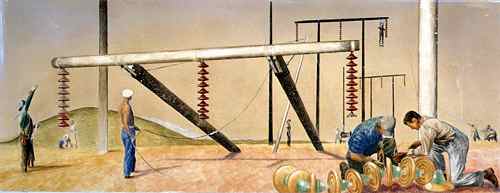
(above: David Stone Martin, Electrification, 1940, Tempera on cardboard. Treasury Section of Fine Arts, Fine Arts Collection, General Services Administration)
WPA murals were explicitly intended to "boost the morale of the American people... by depicting uplifting subjects the people knew and loved". The FAP's easel division emphasized "nationalism and the rediscovery of America". In Florida, this translated into murals celebrating the history of flight (George Snow Hill) or bas-reliefs depicting "Children at Play" (Joan van Breemen). This indicates that public art became a vital medium for reinforcing collective identity, celebrating progress, and fostering optimism, even in the face of widespread despair. It allowed for a localized expression of broader national ideals.
Despite existing societal barriers, the WPA notably provided "unprecedented access to art-making and exhibition opportunities" for women and people of color. The establishment of "Negro Art Centers" in Jacksonville and West Tampa and the support for artists like Augusta Savage highlight a conscious effort to broaden participation and representation in the arts. This led to the creation of art that reflected diverse experiences and actively aimed to uplift marginalized communities, contributing to themes of positive virtues and lifting spirits in a more inclusive manner.
Artist Spotlight: Arnold Blanch (1896-1968) Born in Minnesota, Arnold Blanch studied at the Art Students League, where his artistic perspective was shaped by mentors like Robert Henri and the writings of Walt Whitman. He became an early and long-term winter resident of Key West, starting in 1916 and continuing for over five decades. Blanch was also a significant educator, holding guest instructor positions at various Florida art institutions in Palm Beach, Sarasota, and Key West throughout the late 1930s. He was a notable WPA muralist, contributing to public art during the Depression era.Blanch's artistic focus often centered on the "fruits of the earth, the hills and the fields," reflecting a deep connection to the land and its bounty.
As a muralist for the Treasury Department (a New Deal art program), his work contributed to the public art initiatives that aimed to uplift national morale. His style, like that of his artist wife Lucile Blanch, successfully bridged "realism and abstraction". In the context of the WPA, his art would have depicted American life and labor, portraying these subjects with a blend of realism and an underlying positive message, celebrating the dignity of work and the resilience of the American spirit.
Artist Spotlight: Augusta Savage (1892-1962) Born in Green Cove Springs, Florida, Augusta Savage was a formidable sculptor and activist who overcame significant barriers of poverty, racism, and sexism to become a leading figure of the Harlem Renaissance. She was an influential teacher and mentor, particularly for African American artists. Despite the hardships of the Great Depression, Savage continued to create powerful works, including busts of prominent Black leaders. In 1937, she was appointed the first director of the Harlem Community Art Center.
Savage's art was a direct response to the fight against racism, using her sculptures to celebrate African American identity and advocate for civil rights. Her early work included religious sculptures, which even changed her father's initial disapproval of her art. Her acclaimed sculpture Gamin (French for "street urchin"), a portrait of her nephew, captured both physical likeness and the subject's intrinsic personality, blending artistry with "social commentary" on the experiences of African Americans. Her most iconic work, The Harp (also known as Lift Every Voice and Sing), created for the 1939 New York World's Fair, was a monumental 16-foot plaster sculpture. Inspired by James Weldon Johnson's "black national anthem," it depicted stylized Black singers forming the strings of a harp, with the hand of God at the base, symbolizing "unity and aspiration" and celebrating the "musical contributions of African Americans". Though tragically destroyed after the fair due to lack of funds for casting in metal , its message was profoundly uplifting, embodying positive virtues and the collective spirit of a people.
Augusta Savage's life and work exemplify how art can transcend mere aesthetics to serve a profound social purpose. Her sculptures, particularly Gamin and The Harp, were not just beautiful forms but direct expressions of African American identity, resilience, and aspiration. Her activism against racism and sexism and her dedication to mentoring other Black artists demonstrate a conscious use of art as a tool for social change and upliftment. This goes beyond simply depicting beauty; it actively cultivates positive virtues and lifts spirits by challenging oppression and fostering a sense of dignity and community.
Artist Spotlight: George Snow Hill (1898-1969) A St. Petersburg-based artist, George Snow Hill was a significant contributor to Florida's public art landscape during the WPA era. He was commissioned as a WPA artist to create murals for public spaces. Hill is best known for "The Art of Flight," a collection of seven WPA murals painted in the late 1930s for Tampa's newly built Peter O. Knight Airport.
These murals artistically interpreted the history of human flight through a series of iconic figures and events, including Icarus and Daedalus, Archimedes, the Montgolfier Brothers, Otto Lilienthal, Tony Jannus (pilot of the first scheduled airline flight), and the Wright Brothers. The overarching inspiration was to celebrate "human ingenuity and the heroic spirit of flight," explicitly designed to "boost the morale of the American people suffering from the effects of the Depression by depicting uplifting subjects the people knew and loved". Hill's work, influenced by muralists like Diego Rivera and Thomas Hart Benton, captured "the innocence and joy of life in Florida in the 1930s," making his contributions a direct embodiment of positive virtues and upliftment.
Artist Spotlight: Joan van Breemen (active 1930s) While specific biographical details are sparse, Joan van Breemen was an active sculptor during the WPA era in Florida, contributing significantly to public art initiatives. Van Breemen is recognized for her WPA bas-relief sculptures, particularly the "Children at Play" series. These sculptures were widely installed in 127 public schools, libraries, and other public buildings across Florida, including Hurricane-Refuge schools in the Upper Keys. The themes emphasized "nationalism and the rediscovery of America," depicting innocent and joyful scenes of children engaged in activities like playing baseball, swinging, or riding tricycles.
The placement of these works in public spaces, especially schools, aimed to provide art education and foster community spirit. With their focus on the innocence and vitality of childhood, van Breemen's sculptures offered a subtle yet powerful message of hope, continuity, and normalcy during the challenging years of the Depression, directly contributing to the "lifting of peoples' spirits."
While not as grand as large-scale murals, Joan van Breemen's "Children at Play" bas-reliefs, strategically placed in schools and public buildings, served a crucial purpose. In a period marked by economic hardship and the threat of natural disasters, these depictions of joyful, everyday childhood activities provided a comforting and optimistic vision of the future. They symbolized continuity, innocence, and the enduring spirit of the community. This subtle form of public art directly contributed to the "lifting of peoples' spirits" by offering moments of beauty and normalcy, reinforcing a sense of hope and stability in challenging times.
Conclusion: A Legacy of Light and Hope
The period from 1885 to 1945 witnessed the profound evolution of oil painting and sculpture in Florida, deeply intertwined with the state's rapid development and societal shifts. From the Gilded Age's burgeoning tourism to the resilience of the Depression era, artists consistently found inspiration in Florida's unique landscape and the human experience within it.
The establishment of significant art institutions and collections, such as The Wolfsonian-FIU (established 1986), which specifically focuses on art and design from 1885-1945, underscores the lasting historical and cultural importance of this era. Similarly, the founding of the Ringling College of Art and Design in 1931 further cemented Florida's role as a growing center for artistic education and appreciation. Contemporary scholarly works, such as Deborah C. Pollack's "Florida Sculptors and Their Work 1880-2020," continue to highlight how Florida's "natural beauty, distinctiveness, and warmth" have attracted and inspired artists for centuries.
A consistent thread woven through the entire 1885-1945 period is the profound and enduring influence of Florida's natural environment on its artists. From Martin Johnson Heade's serene marshlands to George Inness Jr.'s spiritual interpretations of the landscape, and even Frederic Carl Frieseke's distant childhood memories, the state's inherent beauty served as a primary muse. Even during the challenging Depression years, WPA artists like George Snow Hill celebrated human achievement through flight and Joan van Breemen depicted the simple joys of childhood.
This continuity suggests that Florida's distinctive character
fostered a pervasive sense of optimism and an appreciation for beauty that
transcended economic and social upheavals, making it a unique canvas for
art that consistently aimed to uplift and inspire. The artists discussed
-- Heade, Inness Jr., Frieseke, Blanch, Savage, Hill, and van Breemen --
each, in their unique way, contributed to a rich artistic legacy in Florida.
Their works, whether through the luminous realism of natural landscapes,
the spiritual idealism of mystical scenes, the intimate beauty of domestic
life, or the public messaging of WPA murals and sculptures, consistently
emphasized beauty, celebrated positive virtues, and sought to uplift the
human spirit. This enduring commitment to art as a source of hope and inspiration
remains a defining characteristic of Florida's artistic heritage from this
pivotal period.
Please don't rely on this AI-generated
text for accuracy. It has been lightly edited, yet may be laden with inaccurate
information. Consider it a base for further inquiry.
 return to AI Curiosities
*Tag for expired US copyright of object image:

TFAO Museum of American Art is proudly sponsored by Traditional Fine Arts Organization, Inc., an Arizona nonprofit corporation. All rights reserved. © 2024
Links to sources of information outside of this website are provided only as referrals for your further consideration. Please use due diligence in judging the quality of information contained in these and all other web sites. Information from linked sources may be inaccurate or out of date. TFAO neither recommends or endorses these referenced organizations. Although TFAO includes links to other web sites, it takes no responsibility for the content or information contained on those other sites, nor exerts any editorial or other control over them. For more information on evaluating web pages see TFAO's General Resources section in Online Resources for Collectors and Students of Art History.