
AI Curiosities
Florida Art, 1845-1885: Realism, Idealism, and Inspiration by ChatGPT 4,o, 2025

(above: A. E. Backus, Untitled, courtesy of Larry Stevens. Public domain, via Wikimedia Commons*)

(above: George Catlin, "Smoking Horses," a Curious Custom of the Sauk and Fox, c. 1835-36, oil on canvas, 19.6 x 27.5 inches, Smithsonian American Art Museum. Public domain, via Wikimedia Commons*)
In 1845 Florida became the nation's newest state, but it remained a thinly populated frontier. In those early decades formal art institutions were lacking and few professional painters settled here. Portraitists and mapmakers did record local life, and a handful of visiting artists and travel writers (for example, the explorer-painter George Catlin) passed through, but Florida's art scene was still minimal. Socially and economically, the territory was recovering from the Second Seminole War and then the Civil War. Even as late as the 1850s few Americans viewed Florida as a source of national pride or virtue -- it was mostly exotic wilderness to outsiders. Only with the postbellum era did attitudes begin to change, and this coincided with the rise of Realism and Idealism in art. Realism emphasized truthful, detailed depiction of the natural world, while Idealism (often influenced by Romanticism) celebrated beauty and moral uplift. In Florida, these trends would come together in paintings and sculptures that highlighted the state's warm light, lush landscapes, and the noble spirit of its scenery and people.
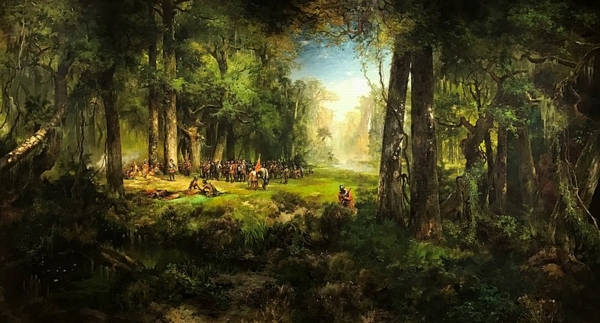
(above: Thomas Moran, Ponce de León in Florida, c. 1877-78, oil on canvas, Cummer Museum of Art and Gardens. Public domain, via Wikimedia Commons*)
PostCivil War Boom and the Florida Landscape, 1865-1885

(above: Thomas Moran, Grand Canyon with Rainbow. 1912. Oil on canvas. de Young Art Museum. Gift of Mr. and Mrs. Robert F. Gill through the Patrons of Art and Music. 1981.89. License: Scuttlebutte, CC BY-SA 4.0 Scuttlebutte, CC BY-SA 4.0. via Wikimedia Commons**)
After the Civil War, Florida's destiny shifted. The Gilded Age economy and new transportation made the state a winter resort for wealthy Northerners. As one museum scholar notes, "the era from 1865 to 1900 became known as the Gilded Age, and Florida became a winter destination for wealthy travelers and adventurers." Industrialists like Henry Flagler built railroads along the East Coast, and steamships brought tourists up the St. Johns River to historic St. Augustine and other towns. Florida's combination of warm climate, long beaches, and exotic subtropical plants quickly captured the imagination: travel guides of the 1880s marketed it as an almost "exotic Eden" of sunlit pines, mangroves, and orchids. In this burgeoning tourist era, landscapes -- not just for their own sake, but as symbols of health and renewal -- became a popular subject. Wealthy travelers often bought small oil paintings or watercolors as souvenirs, and savvy entrepreneurs put art studios in seaside hotels.
Into this scene came a wave of landscape painters who treated Florida much as they had the grand Western or European vistas of earlier years. Many leading American artists made Florida part of their "grand tour." For example, in 1877-78 the British-born Hudson River School painter Thomas Moran visited Fort George Island (near Jacksonville) to sketch palms and riverside scenes. In his 1878 oil Fort George Island, Florida Moran depicts a hazy, idealized coast -- soft blue sky, gently waving palms and sand dunes, with a romantic sense of escape. Indeed, as the Smithsonian notes, Moran's composition suggests "a romantic desert island where people could escape their everyday lives." This painting and others show his brand of American Romanticism: the local scene is rendered with luminous color and meticulous detail (a Realist trait), yet the effect is poetic and uplifting. Moran's work set a tone for many who followed: Florida's forests, marshes and sunsets were depicted not as drab or forbidding, but as awe-inspiring and regenerative.Thomas Moran's Fort George Island, Florida (1878) illustrates the romantic treatment of the tropics. The soft, misty sky and palm-fringed shoreline invite the viewer into an idealized Florida scene.
Likewise, Martin Johnson Heade (1819-1904) came to Florida late in life (moving to St. Augustine in 1883) and adopted its flora as a muse. Heade was an American realist painter known for still lifes and marsh scenes. In Florida he began painting "detailed arrangements of native flowers, including the Cherokee rose, orange blossom, and magnolia." His lush floral still lifes (often with magnolias on velvet, or orchids and hummingbirds) display close naturalistic observation -- each petal and leaf is rendered realistically -- yet they feel sensuous and elegant. In works like Magnolias on Light Blue Velvet Cloth (1885), Heade captures the subtlest play of light and shadow on blossoms, conveying not only botanical accuracy but also a sense of divine beauty. His Florida paintings straddle realism and idealism: they are carefully observed (a Realist impulse) but the effect is rapturous, almost mystical (an Idealist sensibility).Even northern landscape painters who made their names in the mountains ventured south.
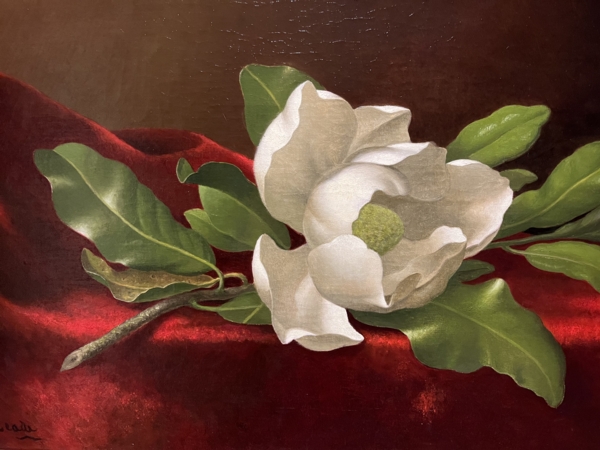
(above: Martin Johnson Heade, Magnolia (detail), c. 1885-95, oil on canvas, 15 x 24 1/8 inches, Saint Louis Art Museum, gift of Mr. and Mrs. John Alden. Public domain*)
Frank Henry Shapleigh (1842-1906), a New Hampshire artist of the White Mountains school, wintered in St. Augustine in the late 1880s. As one art historian notes, Shapleigh "painted throughout New England, in St. Augustine, Florida, California, and in Europe.". He wintered at Flagler's lavish Ponce de Leon Hotel, working en plein air. Shapleigh's Florida canvases brought the crisp composition and perspective of the Hudson River tradition to tropical subject matter. (Likewise, an earlier artist John Bunyan Bristol in 1864 painted Sunset, St. Augustine, Florida from life, mixing exacting detail with romantic glow.) All of these realists treated Florida's everglades, hammocks, and moss-draped oaks with reverence; a 19th-century commentator remarked that "Florida landscape wild, primeval, and exotic, certainly inspired artists with their steady hand and keen eye for beauty."
Significant Artists in Florida
Among the artists who worked in Florida in this era, several have earned special recognition. Thomas Moran as discussed was one of the first big names. An immigrant-born American, he trained in New York and became famous for Yellowstone and Western scenes; his Florida paintings, though few, are celebrated examples of American landscape idealism. Martin Johnson Heade, an American born in Pennsylvania, became an informal leader of the St. Augustine art colony of the 1880s (see Lost Colony: The Artists of St. Augustine, 1930-1950 by Robert W. Torchia). He is often grouped with the Hudson River and Luminist painters, but his Floridian flower-and-bird studies have made him famous as Florida's painter of flowers. (Heade's style was explicitly Realist, nonetheless, his luminous treatment of nature uplifted viewers with its delicate beauty.)
Henry Shapleigh was born in Boston; after Paris training he built a career in New England and Florida alike. In Florida he captured the same sunset light and swamp vegetation that made his mountain scenes so evocative.
An American woman artist of note was Laura Woodward (1834-1926), who began wintering in St. Augustine in the 1880s and later in Palm Beach. Woodward had been a respected Hudson River School painter in New York; by mid-career she found Florida's lush landscapes and unique trees irresistible. A Florida history site calls her "Florida's most important nineteenth-century woman artist." Woodward painted small plein-air studies of mangrove swamps, palmetto glades, and royal poinciana blossoms. Her workhnique but utterly winsome in spirit: a curator notes that she was "captivated by Florida's unspoiled nature" and aimed to promote it through art. For example, her Anastasia Island Lighthouse (1892) -- a tiny oil painting -- shows a striped lighthouse glowing in a golden sunset over sand dunes and palm trees. Contemporary guides had praised the region as "an exotic Eden" of wild beauty, and Woodward's imagery delivers that promise. In her Florida scenes, mosquitoes, snakes and hardship are absent; instead we see tranquil waterlily ponds, sunlit clouds and friendly wildlife. Laura Woodward's 1892 Anastasia Island Lighthouse depicts Florida as an almost Edenic landscape under a warm, pastel sunset. Woodward and her peers used such paintings to celebrate the state's natural virtues, and to show tourists its promise of renewal and beauty.
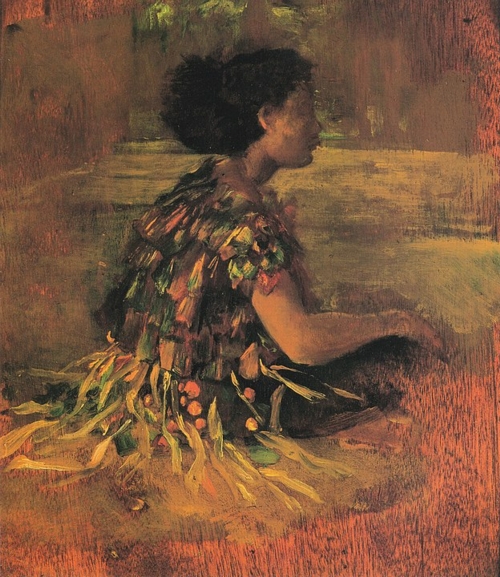
(above: John La Farge, Girl in Grass Dress (Seated Samoan Girl), 1890, oil on panel, 11.9 x 10 inches, Columbus Museum of Art, Museum purchase: Schumacher Fund. Public domain, via Wikimedia Commons*)
Other notable figures include John La Farge and Winslow Homer, who visited Florida briefly (Homer painted some Florida wood-engravings in the mid-1880s, just beyond our period), and naturalists-turned-artists like Titian Ramsay Peale. On the immigrant side, besides Moran's English roots, one might cite early European travelers: for instance, the French artist Achille Devéria published engravings of Florida in the 1850s (after Harriet Beecher Stowe's travels), helping cast Florida as a romantic locale. Yet by 1885 the circle of Florida painters was still dominated by Americans steeped in the wilderness tradition. The only prevalent sculptural works of the era were monuments and architectural details (for example a few Spanish-era carvings in St. Augustine); Florida did not yet have homegrown sculptors of note. Instead, the creative energy focused on painting especially oil landscapes and still lifes conveying a spirit of optimism.
Legacy: Beauty and Uplift in Florida Art
In sum, the half-century from 1845 to 1885 saw Florida evolve from sleepy backwater to muse of American art. Painters working here combined Realism and Idealism in ways that highlighted the state's positive qualities. They rendered swamps and seascapes with accurate detail -- the hallmark of Realism -- yet composed them with light, color and atmosphere that elevated everyday scenes into the sublime. As the Cici and Hyatt Brown Museum has observed, Florida's wild scenery inspired artists "with their steady hand and keen eye for beauty."
In Florida art of this era, images of spreading oaks draped
in Spanish moss, or fields of blooming magnolias, became symbols of a gentler,
more virtuous nature. These works promised that the Sunshine State could
uplift the human spirit by its very appearance. In that sense, the collective
achievement of these painters (and the few sculptural memorials of the time)
was to enshrine Florida's landscape and character as uplifting ideals. They
left a legacy in which Florida's past is remembered not for war or hardship,
but for artistry that emphasized beauty, health, and optimism -- virtues
that would shape the state's identity in art for generations to come.
Please don't rely on this AI-generated
text for accuracy. It has been lightly edited, yet may be laden with inaccurate
information. Consider it a base for further inquiry.
 return to AI Curiosities
*Tag for expired US copyright of object image:

TFAO Museum of American Art is proudly sponsored by Traditional Fine Arts Organization, Inc., an Arizona nonprofit corporation. All rights reserved. © 2024
Links to sources of information outside of this website are provided only as referrals for your further consideration. Please use due diligence in judging the quality of information contained in these and all other web sites. Information from linked sources may be inaccurate or out of date. TFAO neither recommends or endorses these referenced organizations. Although TFAO includes links to other web sites, it takes no responsibility for the content or information contained on those other sites, nor exerts any editorial or other control over them. For more information on evaluating web pages see TFAO's General Resources section in Online Resources for Collectors and Students of Art History.