
AI Curiosities
Ten Most Frequently Exhibited New Mexican Artists (1850-1930) in Southwestern Art Museums
by Gemini 2.5 Pro preview 5/25
The landscape, light, and diverse cultures of New Mexico in the late 19th and early 20th centuries held an undeniable allure for artists from the eastern United States and Europe. Drawn by the promise of unique subject matter and an environment vastly different from their urban experiences, these artists flocked to northern New Mexico, establishing vibrant art colonies in Taos and Santa Fe.
The arrival of Ernest Blumenschein and Bert Phillips in Taos in 1898, captivated by the region's beauty and mystique, is often cited as the beginning of this artistic migration. Various factors contributed to this draw, including the exotic landscapes and inhabitants, the beckoning of artists already established in the region, and the salubrious climate. Many of these pioneering artists, who would later form the Taos Society of Artists, had previously studied together in Paris, bringing with them European academic techniques to apply to their newfound American subjects. The Taos Society of Artists, for example, focused their artistic endeavors on the Southwestern landscape, the unique quality of light, and the rich Native American and Spanish cultures of Northern New Mexico.

(above: Ernest L. Blumenschein
(1874-1960), Star Road and White Sun, 1920, oil, Albuquerque Museum,
Albuquerque, New Mexico. Public domain, via Wikimedia Commons*)
The initial impressions of the Taos Valley, as described by Blumenschein, highlighted its immediate inspirational qualities for those seeking artistic expression. The core motivation for many was to authentically represent the people and landscapes of the Southwest, often with a romantic sensibility. The essence of the attraction was perhaps best summarized as "The land. The people. The light. The air."
As these art colonies flourished, institutions dedicated to preserving and showcasing their artistic output began to emerge in the Southwest. The New Mexico Museum of Art in Santa Fe, established in 1917, stands as the oldest art museum in the state, with a significant collection emphasizing the art of the Southwest, including prominent artists from the Taos Society of Artists and the Santa Fe Art Colony. In Taos, the Harwood Museum of Art, founded in 1923, became a cornerstone for the artistic heritage of the region, committed to presenting the comprehensive story of art in Taos and Northern New Mexico, with a strong representation of early 20th-century artists including the Taos Society.
Although established later in 1963, the University Art Gallery (now the University of New Mexico Art Museum) demonstrated an early interest in the historical art of the region with its inaugural exhibition featuring artists from Taos and Santa Fe. Key museums in Taos, such as the Harwood Museum of Art, the Millicent Rogers Museum, and the Taos Art Museum, now hold collections that reflect the diverse multicultural heritages and artistic influences of the Taos community.
The establishment of these art museums in close proximity to the rise of the art colonies suggests a vital connection. The burgeoning artistic output in Taos and Santa Fe created a demand for institutions to safeguard and exhibit this work, while the presence of these museums, in turn, provided legitimacy and further promoted the artists and their creations. The timeline of the museums' founding, particularly the New Mexico Museum of Art in 1917 and the Harwood in 1923, closely aligns with the active years of the Taos Society of Artists (1915-1927). These museums explicitly state their dedication to the artists and art movements originating from these colonies. This close relationship indicates a mutually beneficial dynamic where the artists provided the artistic content, and the museums offered a crucial platform for its preservation and public appreciation.
A pivotal moment in the history of New Mexican art was the formation of the Taos Society of Artists in 1915, a group that would significantly shape the artistic landscape of the region. The initial meeting in 1915 brought together six accomplished artists: Ernest L. Blumenschein, Oscar E. Berninghaus, E. Irving Couse, Joseph Henry Sharp, Bert G. Phillips, and W. Herbert Dunton. Their stated aim was to "advance the standards of American art and to promote the work of its members through traveling exhibitions." This collective sought to bring their uniquely American artistic visions to a wider audience, and by 1927, the Society had grown to include twelve active members, incorporating artists such as Walter Ufer and Victor Higgins.
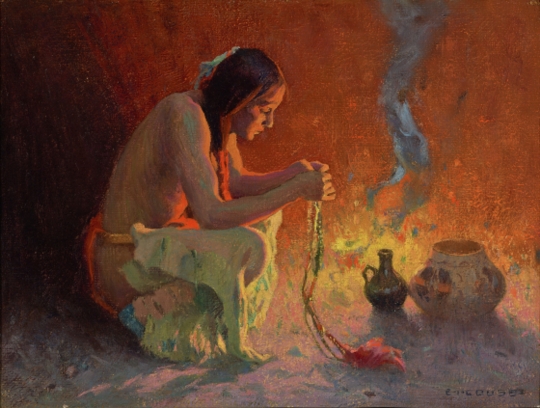
(above: E. Irving Couse, Crouching Indian by a Fire, c. 1910, oil on canvas; 11 3/8 x 15 3/8 inches, Denver Art Museum, Funds from 1986 Collectors' Choice, 1986.8)
The Taos Society of Artists, hailed as a "groundbreaking association of European trained painters," played a crucial role in fostering a significant school of American painting centered around the visually stunning Taos Pueblo. The seeds of this artistic community were sown earlier, with Joseph Henry Sharp's visit to New Mexico in 1893 and his subsequent encouragement of fellow artists like Bert Phillips and Ernest L. Blumenschein, whom he met while studying in Paris. The Society's first exhibition, held at the Palace of the Governors in Santa Fe soon after their formation, indicated early support from established institutions. Functioning essentially as a "commercial cooperative," the Taos Society of Artists significantly contributed to the transformation of Taos into an internationally recognized art center. Membership in the Society required artists to have worked in Taos for at least three consecutive years, demonstrate a focus on painting Native Americans, and have exhibited in reputable galleries, ensuring a level of artistic commitment and professionalism. The Society's purpose, as stated at their first meeting in 1915, was to promote the exhibition and sale of their artwork. These artists were driven by a desire to faithfully represent the people and landscapes of the Southwest, sharing their unique vision with the nation and the world.
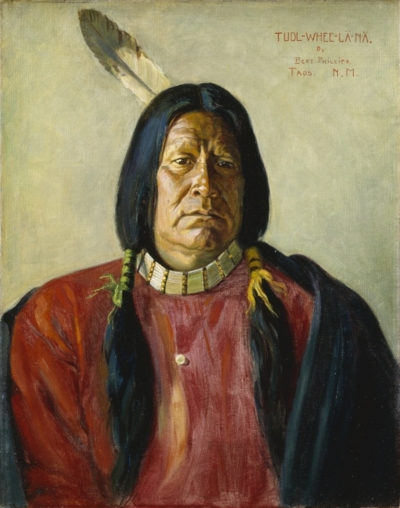
(above: Bert Geer Phillips, Tudl-Whee-La-Na, oil on canvas 17 1/2 x 13 1/2 inches, Denver Art Museum, William Sr. and Dorothy Harmsen Collection. 2001.1148.
Alongside the formal organization in Taos, a less structured but equally influential art scene emerged in Santa Fe. Santa Fe became a hub for artists who were particularly drawn to the Hispanic culture and traditions of the region. The "old guard" of the Santa Fe Art Colony, including artists like Carlos Vierra, Sheldon Parsons, Warren E. Rollins, and Gerald Cassidy, began exhibiting their work at the Palace of the Governors as early as 1916. In contrast to the Taos artists, many early Santa Fe visitors were initially illustrators for Eastern magazines or were commissioned by the burgeoning railroad industry to capture the Western landscapes.
The Santa Fe art colony developed somewhat organically, attracting artists for various reasons, including the clear light, the dramatic landscape, and for some, the hope of relief from respiratory ailments in the arid climate. In 1921, a group known as Los Cinco Pintores, including Will Shuster, Willard Nash, W.E. Mruk, Josef Bakos, and Fremont Ellis, formed in Santa Fe, embracing a more contemporary artistic style. Santa Fe also attracted established artists like Robert Henri and John Sloan, who, while not permanent residents, were drawn to the ethnic imagery and influenced the local art scene. The University of New Mexico Art Museum's early exhibition in 1963 featured artists from both the Taos Society of Artists and the Santa Fe Art Colony, highlighting the interconnectedness of these artistic centers.
While the Taos Society of Artists operated as a formal collective with clear membership and artistic focus centered on the Taos Pueblo and its surroundings, the Santa Fe Art Colony represented a more fluid and diverse gathering of artists. Drawn to Santa Fe for a broader range of motivations, including health and an interest in both Hispanic and Native American cultures, the Santa Fe artists explored a wider spectrum of artistic styles, including early modernism. The emergence of groups like Los Cinco Pintores within Santa Fe, with their emphasis on contemporary art, further distinguishes it from the more traditionally focused Taos Society. This difference in structure and artistic approach highlights the unique character of each art center within the larger context of early New Mexican art.

(above: Gerald Cassidy, Mid Day - Taos Plaza, c. 1918, The Owings Gallery, Santa Fe, NM. Public domain, via Wikimedia Commons*)
Based on the frequency of their mention in connection with museum exhibitions and collections within the provided research material, the following ten artists emerge as the most frequently exhibited New Mexican artists for paintings created between 1850 and 1930:
These artists, central to the early New Mexican art scene, brought a diverse range of artistic styles and techniques to their depictions of the region. The Taos Society Artists, in general, synthesized their European academic training with the unique subject matter of the American Southwest.
Blumenschein's early works showed the influence of French Impressionism and Post-Impressionism before he became a key figure in the Taos Society and helped shift perceptions of Native American cultures.
Phillips was drawn to painting Native American subjects in a romantic style, often using firelight for dramatic effect, although his later works featuring Hispanic subjects are now highly acclaimed.
Couse often idealized his Native American subjects, portraying them in peaceful, traditional settings, showcasing his mastery of figure painting.
Sharp is often credited with initiating the art movement in Taos and aimed for ethnographic accuracy in his portrayals of Native Americans, earning him the moniker "the anthropologist."
Berninghaus, initially a commercial lithographer, became renowned for his artistic renderings of Indigenous Americans and the expansive Southwestern landscape.
Dunton, with a background as an illustrator, focused his artistic endeavors on the rugged individuals of the Old West and the region's wildlife, often with a sense of nostalgia.
Ufer, trained in Europe, applied an Impressionistic style to his paintings of the Taos Pueblo genre, frequently incorporating elements of realism and social commentary.
Higgins served as a bridge between traditional academic art and the burgeoning modernist movements, experimenting with multi-point perspective and interlocking planes in his landscapes and figure compositions.
Rolshoven, who spent a significant portion of his career painting in Europe and North Africa, brought a diverse artistic background to his depictions of New Mexico, including the Taos Pueblo and its inhabitants. Cassidy, a key figure in the Santa Fe Art Colony, developed a distinctive realist style with influences of Art Deco in his portrayals of the people and landscapes of the Southwest.
The cultural resonance and significance of these artists' works are profound. The Taos Society of Artists played a pivotal role in establishing Taos as an internationally recognized art colony, attracting both artists and tourists to the region. Their paintings provided a unique glimpse into the previously "unknown world" of the Southwest, capturing the lives and traditions of Native American and Hispanic communities for a wider audience. They aspired to create a distinctly "American Art" that was deeply rooted in the unique imagery and symbolism of the region.
Artists like Blumenschein actively contributed to a changing understanding of Native American cultures, while Ufer's work sometimes addressed social issues, questioning cultural dominance. Sharp's meticulous documentation of Native American life through his paintings holds significant historical value. The artists of the Santa Fe Art Colony, while operating with less formal structure, also made substantial contributions to the cultural identity of the Southwest, often focusing on the rich Hispanic heritage and advocating for the preservation of Spanish colonial art. Notably, Carlos Vierra's passionate advocacy for the Pueblo Revival Style had a lasting impact on the architectural character of Santa Fe.
Southwestern art museums have consistently favored the exhibition of these ten artists due to a compelling combination of their artistic merit and cultural significance to the region. Museums such as the New Mexico Museum of Art and the Harwood Museum of Art have a core mission to preserve and showcase the artistic and cultural heritage of the Southwest. The works of these ten artists directly align with this mission, representing key figures and artistic movements from the early 20th century in New Mexico.
The demonstrable artistic skill and unique stylistic approaches of these painters ensure the aesthetic value and enduring appeal of their work to museum visitors. Furthermore, the cultural significance of their paintings, which documented the landscapes, people, and traditions of the Southwest, provides an invaluable historical and cultural context that is central to the narratives these regional museums aim to convey. The national and even international recognition garnered by many of these artists during their careers and in the years since their passing further solidifies their importance in museum collections.
In conclusion, the ten New Mexican artists identified - Ernest L. Blumenschein, Bert G. Phillips, E. Irving Couse, Joseph Henry Sharp, Oscar E. Berninghaus, W. Herbert Dunton, Walter Ufer, Victor Higgins, Julius Rolshoven, and Gerald Cassidy -represent a foundational chapter in the art history of the American Southwest. Their artistic contributions, ranging from romantic portrayals to impressionistic landscapes and early modernist explorations, captured the unique visual and cultural landscape of New Mexico during a transformative period. Their works hold enduring cultural significance, having shaped the perception of the Southwest both nationally and internationally, and continue to be celebrated and exhibited in Southwestern art museums as vital expressions of the region's rich artistic heritage.
Please don't rely on this AI-generated text for accuracy. It has been lightly edited, yet may be laden with inaccurate information. Consider it a base for further inquiry.
 Return to New Mexico Art History
Return to AI Curiosities
Return to Research Projects, Reports and Studies
*Tag for expired US copyright of object image:

TFAO Museum of American Art is proudly sponsored by Traditional Fine Arts Organization, Inc., an Arizona nonprofit corporation. All rights reserved. © 2024
Links to sources of information outside of this website are provided only as referrals for your further consideration. Please use due diligence in judging the quality of information contained in these and all other web sites. Information from linked sources may be inaccurate or out of date. TFAO neither recommends or endorses these referenced organizations. Although TFAO includes links to other web sites, it takes no responsibility for the content or information contained on those other sites, nor exerts any editorial or other control over them. For more information on evaluating web pages see TFAO's General Resources section in Online Resources for Collectors and Students of Art History.