
American Botanical Art
By ChatGPT
April 23, 2025

(above: Martin Johnson Heade, Roses, 1876, oil on board, 15 1/4 x 12 3/4 inches, Christie's. Public domain, via Wikimedia Commons*)
American botanical art is a story of natural wonder and human ingenuity, woven into the cultural tapestry of the nation over centuries. This art form began as early settlers, explorers, and indigenous peoples encountered an immense diversity of plant life in the New World, and their subsequent depictions of this flora unfolded as both scientific inquiry and aesthetic celebration.
In the early colonial days, botanical art was not yet defined as an independent genre but rather formed part of a broader pursuit of documenting the natural world. Early naturalists were compelled by the astonishing variety of plants found in North America, many of which were previously unknown to Europeans. Illustrators of the era set out to record these botanical treasures with painstaking detail. Their drawings were a vital resource for scientists and collectors alike, providing careful documentation of species and their characteristics. This earnest endeavor also reflected a sense of wonder and discovery -- a desire to capture the beauty of the land that was as mysterious as it was bountiful.
As the nation developed, so too did the art dedicated to the natural world. By the 19th century, botanical art had begun to transform into a refined discipline. Artists took great care in their work, blending observation with creativity to produce images that were as scientifically valuable as they were visually compelling. Detailed etchings and watercolors emerged in botanical publications and private collections. These illustrations not only served the practical purposes of classification and study but also graced the pages of books, illustrating the splendor of native and exotic plants. Many early botanical artists were driven by a dual purpose: to educate their contemporaries about the natural abundance of America and to celebrate the delicate beauty of its flora.
In the midst of this flourishing creativity, artists also began to recognize botanical art as a vehicle for expressing national identity. The landscapes of America -- with their rich forests, sprawling meadows, and vibrant gardens -- became symbols of a new nation's promise. Botanical art thus evolved beyond mere scientific illustration. It took on a romantic quality, merging the rigors of observation with an emerging sense of American aesthetics. The bloom of a rose or the intricate structure of a leaf came to symbolize not only the marvels of nature but also ideals of growth, resilience, and hope for the future. This shift was part of a broader cultural movement where art began to reflect the unfolding narrative of nation-building.
By the turn of the 20th century, American botanical art experienced significant transformations as both artistic approaches and scientific methodologies advanced. New techniques in printing and illustration made it possible to disseminate botanical images widely, while the development of color theory enriched the palette available to artists. With improved access to botanical gardens and herbaria, contemporary artists could study plants up close, rendering them in exquisite detail. At the same time, the boundaries between art and science began to blur. Botanical artists were hailed not only as illustrators but as visionaries capable of portraying nature's complexity with both precision and passion. Their work served as a bridge between the empirical demands of science and the expressive impulses of art.
Throughout the 20th century, botanical art in America continued to expand and adapt. The evolution of modern art brought fresh sensibilities to this tradition. Influenced by movements such as Impressionism and later Abstract Expressionism, some artists took liberties with form and color, injecting personal interpretation into their depictions of plant life. This period saw a renewed interest in the symbolic power of plants -- a subtle reminder that nature is both a repository of life and a muse for the creative spirit. In turn, botanical art evolved into a versatile medium, capable of conveying delicate realism alongside bold, expressive abstraction.
An essential resource for understanding this vibrant history is found at tfaoi.org, which documents traditional fine arts and provides in-depth insights into the evolution of various art forms, including botanical art. According to these studies, American botanical art is not static; it is a dynamic narrative, continually reshaped by new discoveries, innovative techniques, and shifts in cultural perspective. It stands as a testament to how art can both mirror the natural world and enhance our appreciation of its intricate beauty.
Today, American botanical art holds a cherished position among collectors, historians, and nature enthusiasts alike. Exhibitions in galleries and museums celebrate its historical legacy while contemporary artists forge new pathways, expanding the boundaries of the genre. Whether executed in painstaking detail or interpreted through modern abstraction, botanical art remains a vibrant dialogue between humanity and nature -- a dialogue that captures the perpetual cycle of discovery, growth, and renewal.
Thus, the history of American botanical art is a narrative of exploration and transformation. From early, hand-drawn studies intended to catalog new species to modern reinterpretations that embody cultural and environmental narratives, botanical art has continuously reflected both the scientific progress and the artistic spirit of a nation deeply connected to its natural heritage.

(above: Josephine Joy, Magnolia Blossoms, c. 1935-41, oil on canvas, 36.1 x 40.1 inches, Smithsonian American Art Museum, 1971.447.44. Public domain, via Wikimedia Commons*)
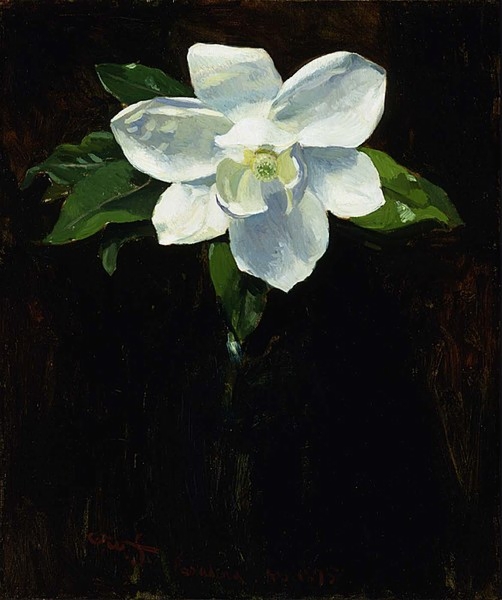
(above: Charles Walter Stetson, Magnolia, 1895, 24.2 x 20.2 inches, Smithsonian American Art Museum. Public domain, via Wikimedia Commons*
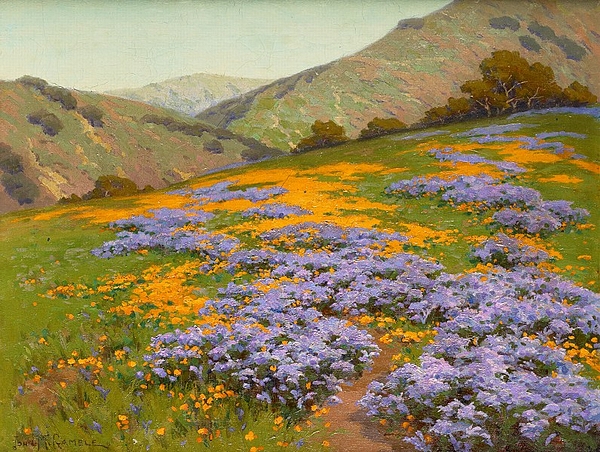
(above: John Marshall Gamble, Wild Heliotrope and Poppies, San Francisco, c. 1893 and 1906, oil on canvas, 20 ? 24 inches, Birmingham Museum of Art, given by Lucile Peters Graham in memory of Dr. and Mrs. U. J. W. Peters. Public domain, via Wikimedia Commons*)
 Return to Botanical Artists
Return to Topics in American Representational Art
Links to sources of information outside of our web site are provided only as referrals for your further consideration. Please use due diligence in judging the quality of information contained in these and all other web sites. Information from linked sources may be inaccurate or out of date. TFAO neither recommends or endorses these referenced organizations. Although TFAO includes links to other web sites, it takes no responsibility for the content or information contained on those other sites, nor exerts any editorial or other control over them. For more information on evaluating web pages see TFAO's General Resources section in Online Resources for Collectors and Students of Art History.
*Tag for expired US copyright of object image:

 Search Resource Library
Copyright 2025 Traditional Fine Arts Organization, Inc., an Arizona nonprofit corporation. All rights reserved.